
Posted on — Leave a comment

Walk-In Shower Remodel Cost: Materials vs Labor

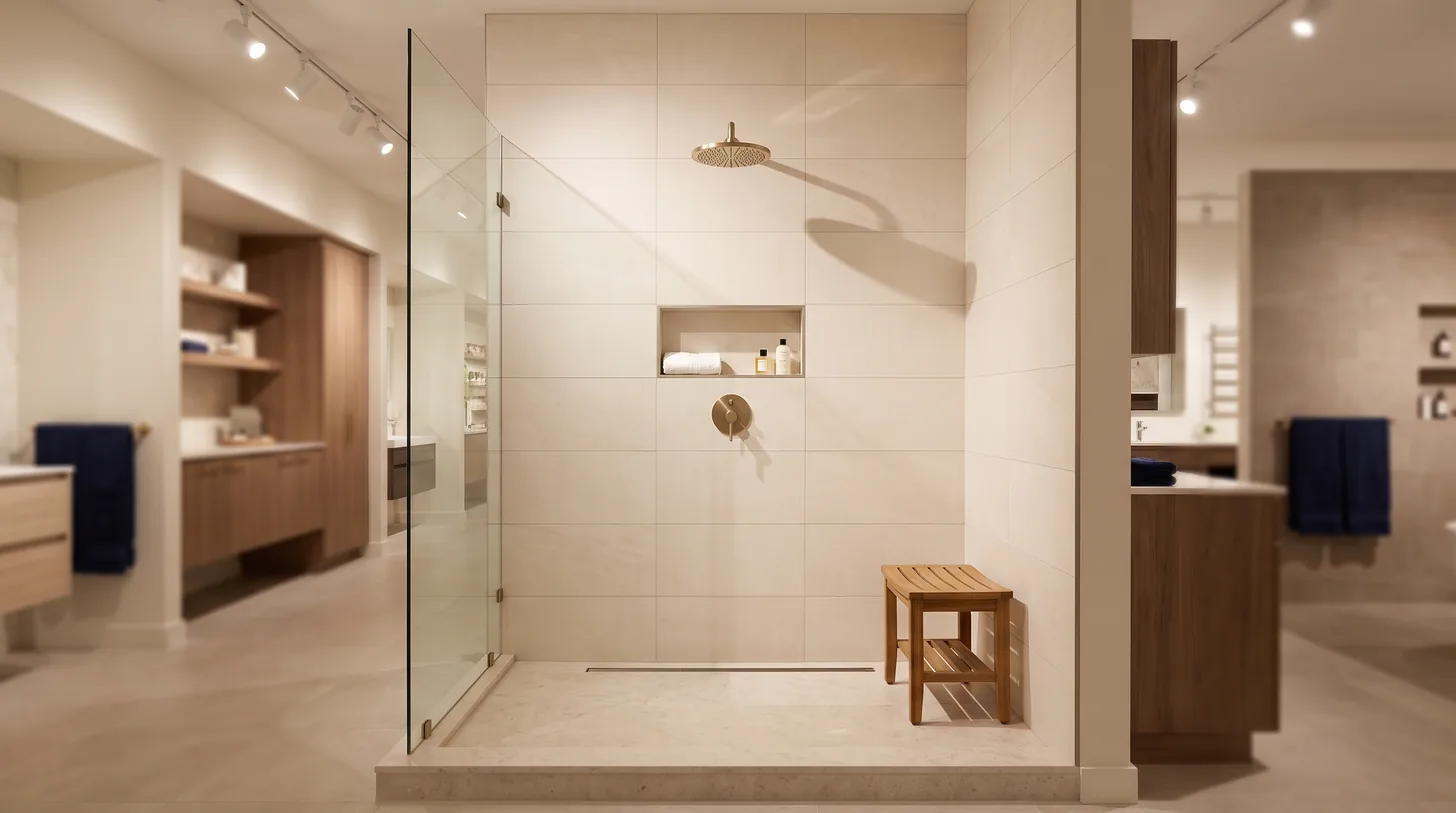
Walk in shower cream tile gold fixtures showroom

A walk-in shower remodel costs $8,000 to $15,000 for a standard tiled shower and $4,000 to $7,000 for an acrylic surround. A curbless shower with a linear drain runs $14,000 to $25,000. In every tiled version, labor is roughly 55 percent of the total and tile is about 12 percent, which is why two showers with the same tile can be quoted $6,000 apart.

Most shower cost articles are written by somebody who sells one half of the job. The tile shop quotes material and waves at installation. The contractor quotes labor and guesses at material. H&C Kitchen & Bath sits on both sides: we are a Derwood showroom that supplies tile, fixtures and glass, and our sister company H&C Construction executes the work. The split below comes from seeing both invoices on the same job.

What a walk-in shower costs, by type

Type Range What it is Typical timeline
Acrylic surround $4,000 to $7,000 Three-piece or single-piece acrylic wall set, standard pan, framed glass 3 to 5 days
Standard tiled $8,000 to $15,000 Tiled walls over waterproofing, preformed or mud-set pan, semi-frameless glass 2 to 3 weeks
Curbless, linear drain $14,000 to $25,000 Recessed subfloor, sloped mud bed, linear drain, frameless glass 3 to 4 weeks
Wet room or custom stone $25,000+ Full enclosure waterproofed, large-format stone, body sprays, bench 4 to 6 weeks

In the Montgomery County, Maryland market these ranges land about 8 to 12 percent above the national mid-point, driven by labor rates and permit review time, not by material prices.
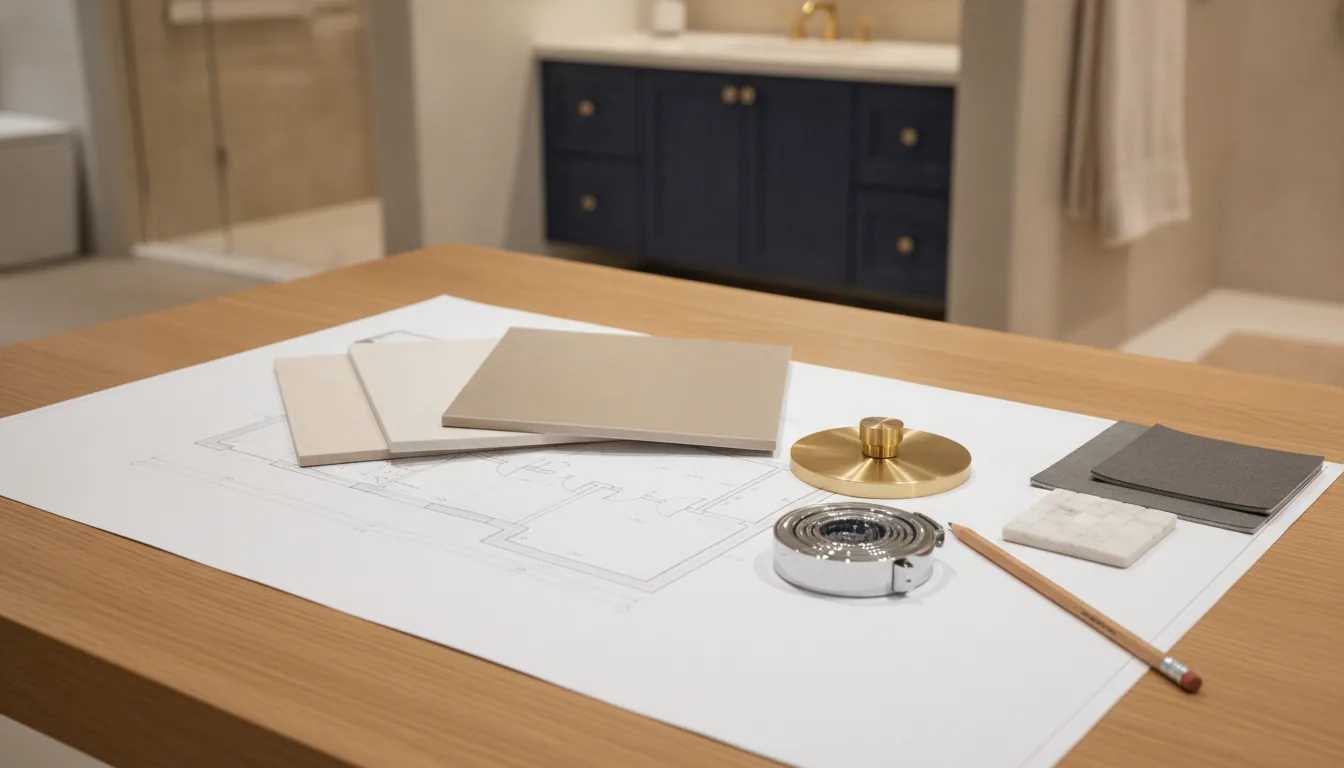
Bathroom tile samples and floor plan on design table

Where the money actually goes

This is the table nobody publishes, because it requires seeing both invoices. Percentages are for a standard tiled walk-in shower in the $8,000 to $15,000 band.

Line item Share of total Notes
Labor, all trades 55% Demo, framing, plumbing, waterproofing, setting, grouting, glass install
Glass enclosure 14% Semi-frameless $900 to $1,800, frameless $1,800 to $3,500
Tile 12% The line everyone shops, and the smallest one that matters
Waterproofing and substrate 8% Membrane, backer board, pan assembly, corners
Plumbing fixtures 7% Valve, trim, head, diverter
Permits, disposal, misc 4% Higher where plan review is slow

The practical consequence: upgrading your tile from $4 to $9 per square foot adds about $450 to a shower. Moving the valve wall three feet adds about $2,200. People spend weeks on the first decision and minutes on the second.

The four decisions that move the number

Does the drain stay where it is. A shower that reuses the existing drain location is a straightforward job. Relocating it means opening the floor, and on a slab that means cutting concrete. This single decision is worth $1,500 to $4,000.

Curb or curbless. Curbless looks simple and is not. The subfloor has to be recessed or the whole bathroom floor raised so the shower can slope to drain. Budget $3,000 to $6,000 over a curbed equivalent and expect the schedule to grow by a week.

Tile size. Large-format tile uses less grout and reads more expensive, but it needs a flatter substrate and more labor to set. Mosaic on a shower floor is the opposite: cheap material, slow to set. The install cost moves more than the tile cost does.

Glass. Semi-frameless and frameless look similar in a photo and are not similar in price. Frameless needs thicker glass, heavier hardware and a second visit to template after the tile is set.
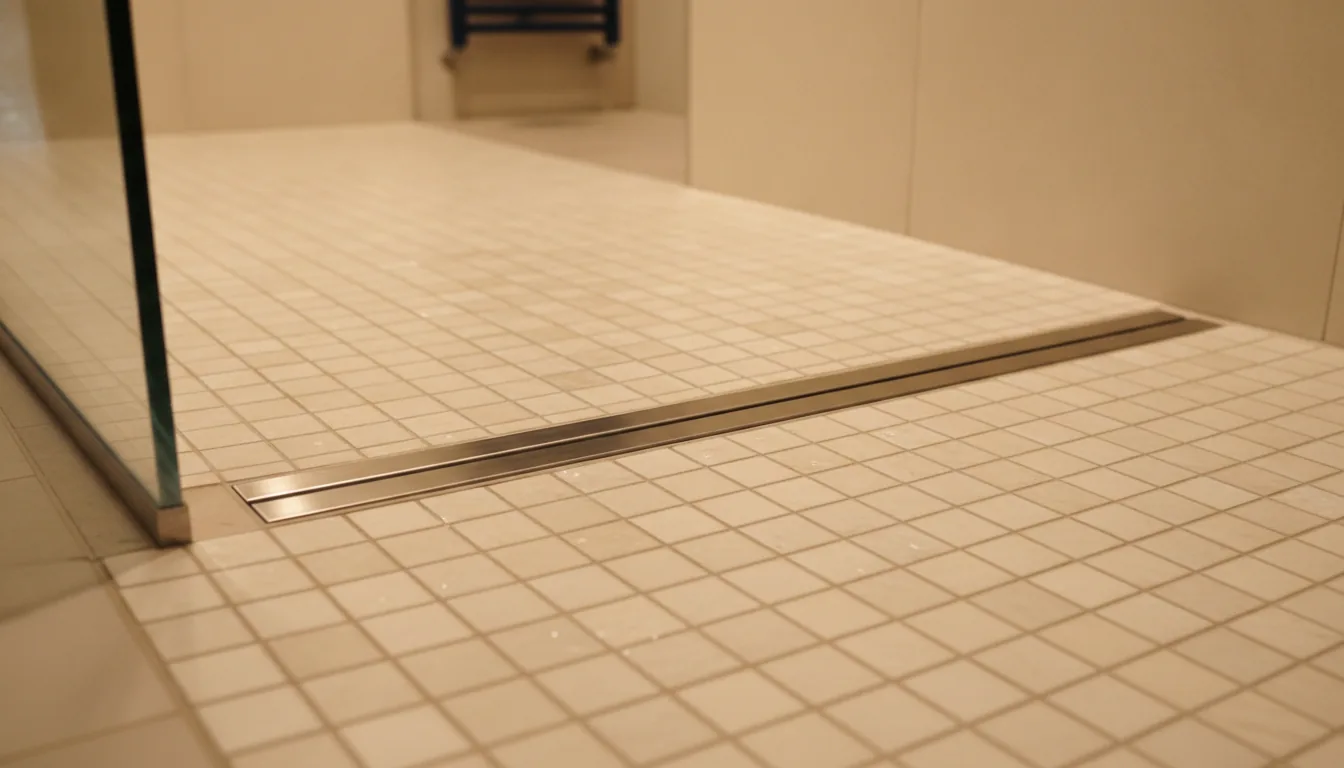
Linear drain in marble mosaic shower floor

Tub to shower, specifically

If you are converting rather than replacing, the demo and plumbing change. Removing a tub and framing the new opening runs $900 to $2,000 on top of the shower itself, and if the tub was fiberglass against a window, expect wall repair. We cover that job separately in what it costs to remove a tub and install a shower.

One thing worth knowing before you decide: in a one-bathroom house, removing the only tub can affect resale with families. In a second bathroom it almost never does.

Why quotes differ so much

Three showers with identical tile can be quoted $9,000, $12,000 and $18,000, and all three can be honest. The differences are usually waterproofing method, glass spec and whether the quote includes the trades the showroom cannot do. Ask every bidder the same three questions: what waterproofing system, what glass thickness and framing, and is plumbing rough-in included or excluded.

A quote that is 30 percent below the others is usually not a better deal. It is a different scope.

Frequently asked questions

How much does a walk-in shower cost on average?

A standard tiled walk-in shower averages $8,000 to $15,000 installed. An acrylic surround averages $4,000 to $7,000. A curbless shower with a linear drain averages $14,000 to $25,000. Labor is roughly 55 percent of a tiled job.

Is a walk-in shower cheaper than a tub?

No. A basic alcove tub with a tile surround is usually cheaper than a comparable tiled walk-in shower, because the tub replaces the pan assembly and part of the waterproofing. A walk-in shower costs more and is chosen for use, not for price.

How long does a walk-in shower remodel take?

Three to five days for an acrylic surround, two to three weeks for a standard tiled shower, and three to four weeks for curbless. Tile setting and curing, not demolition, set the schedule.

Does a walk-in shower add value to a home?

In a primary bathroom, generally yes, and it is one of the more reliable bathroom upgrades for resale. In a single-bathroom house, removing the only tub can narrow your buyer pool with young families, which offsets the gain.

What is the cheapest way to redo a shower?

Keep the drain where it is, keep the valve on the same wall, choose an acrylic surround over tile, and accept a framed or semi-frameless door. Those four choices together are the difference between roughly $4,500 and roughly $12,000.

Want a real number for your bathroom? Bring your dimensions to our Derwood showroom and we will price the same shower in acrylic, standard tile and curbless so you can see exactly what each step up buys. Call (301) 939-0009 or book a showroom visit.
Posted on — Leave a comment

How Much Does a Bathroom Remodel Cost? Real Numbers by Scope

A bathroom remodel costs $8,000 to $80,000 depending on the room. A powder room runs $8,000 to $15,000. A guest or hall bath runs $18,000 to $35,000. A primary bathroom runs $40,000 to $80,000. The cost driver that separates tiers is not size, it is wet area: how much tiled, waterproofed surface the job creates.

Bathroom costs hinge on wet area and whether fixtures move, and both are things somebody has to look at. Have H&C Construction assess your bathroom and put a real number on the scope.

Bathrooms cost more per square foot than kitchens. A 40 square foot bathroom can cost as much as a 200 square foot kitchen refresh, because nearly every trade works in that small room and because water makes mistakes expensive.

Cost by room type

Room Typical size Cost range What is included
Powder room 15 to 25 sq ft $8,000 to $15,000 Vanity, toilet, faucet, floor tile, lighting, paint
Guest or hall bath 35 to 60 sq ft $18,000 to $35,000 Above plus tub or shower, tile surround, exhaust, waterproofing
Primary bath 80 to 150 sq ft $40,000 to $80,000 Above plus double vanity, separate shower, glass, often heated floor
Primary with structural change 100+ sq ft $80,000 to $150,000+ Above plus moved walls, relocated plumbing, new window

Why wet area drives the price

A powder room has no shower. That single fact removes waterproofing, tile surround, shower valve, glass, and drain work, which is why it costs a third of a full bath at similar finish level.

The moment a job includes a shower, it includes:

  • Waterproofing membrane over the substrate, correctly lapped and sealed
  • Sloped mortar bed to the drain
  • Tile surround, priced by square foot of wall, not floor
  • Shower valve and rough-in, which is inside the wall and cannot be changed later without demolition
  • Glass, typically $1,200 to $3,500 for frameless

Waterproofing is the line item homeowners cut and the one that causes failures. A shower that leaks behind tile does not announce itself for two years, and then the repair is the entire bathroom plus the ceiling below it.

Line by line: a $28,000 guest bathroom

Line item Range
Labor and installation $9,000 to $12,000
Tile, materials only $1,800 to $3,500
Vanity and top $1,500 to $4,500
Shower or tub unit $1,200 to $3,500
Shower glass $1,200 to $3,000
Plumbing fixtures, faucet, valve, toilet $1,500 to $3,500
Waterproofing and substrate $900 to $1,800
Electrical, lighting, exhaust fan $1,200 to $2,500
Permits and contingency $1,500 to $2,500

Note that labor is roughly 35 to 40 percent of a bathroom, higher than a kitchen’s 22 percent. Small room, many trades, tight sequencing.

What pushes a bathroom into the next tier

Moving the toilet. The drain is the constraint. A toilet drain needs specific slope and venting, and relocating it in a home with a slab foundation means cutting concrete. Budget $1,500 to $4,000.

Converting tub to shower. Common in primary bathrooms and generally worth it for daily use, though real estate advice varies if it leaves the home with no tub at all. Cost depends on drain relocation and whether the opening changes.

Curbless or barrier-free showers. Increasingly requested for aging in place. Requires recessing the subfloor or building up the entire floor, so the cost is structural, not cosmetic. Add $3,000 to $8,000.

Heated floors. Electric mats add $1,200 to $3,000 installed on a typical bathroom and require a dedicated circuit and thermostat.

Double vanity in a single vanity space. Often requires moving a supply line and drain, and sometimes a wall.

Where you should and should not economize

Worth the money:

  • Waterproofing, always
  • The shower valve, because it lives inside the wall
  • Exhaust ventilation sized correctly for the room, which prevents mold
  • The vanity, since it takes daily abuse and cheap boxes swell

Reasonable places to save:

  • Tile selection, where a well-chosen porcelain at $4 per square foot can outperform a poorly chosen stone at $14
  • Keeping fixtures in place
  • Standard shower size rather than custom glass dimensions
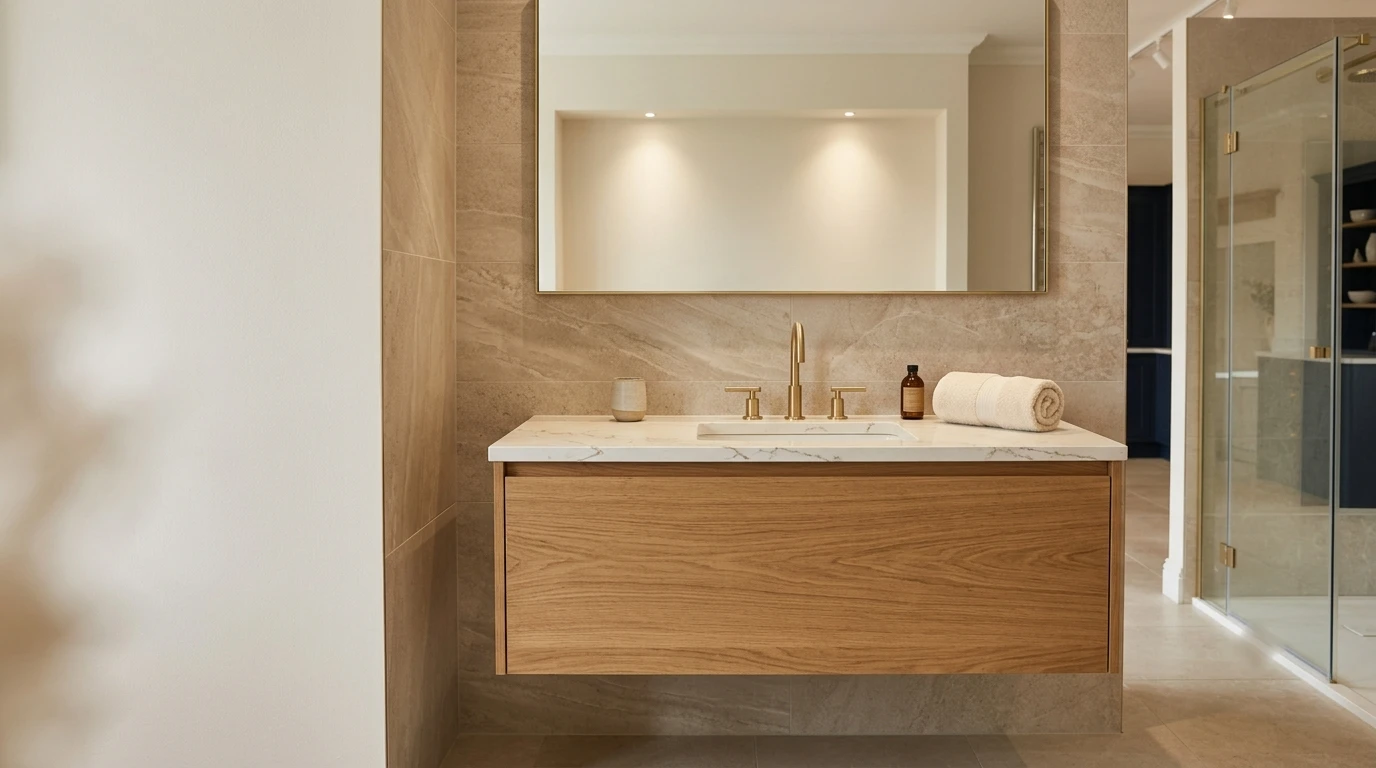
  • A quality stock vanity instead of custom millwork, which is where our bathroom vanities in Maryland selection tends to pay off

Maryland and Montgomery County specifics

Bathroom projects here run 15 to 25 percent above national averages. Two local factors matter:

Older housing stock. Homes in Bethesda, Silver Spring, Takoma Park, and Kensington built before 1970 frequently have galvanized supply lines, cast iron drains, or original subfloor damage discovered at demolition. We budget contingency for this rather than discovering it as a change order.

Permits. Montgomery County requires permits for plumbing and electrical work in bathrooms. Ventilation and GFCI protection are inspected. Verify current requirements with the Montgomery County Department of Permitting Services.

How long it takes

A guest bathroom typically takes 3 to 5 weeks of active work. A primary bathroom takes 5 to 8 weeks. Add 3 to 6 weeks before that for design, selections, and material lead times, longer if tile or vanities are special order.

The schedule risk in bathrooms is almost always tile and glass. Glass cannot be measured until the tile is set, and fabrication takes 1 to 2 weeks after templating. Plan for it rather than being surprised by it.

Frequently asked questions

How much does a bathroom remodel cost in Maryland?

A bathroom remodel in Maryland costs $8,000 to $80,000 depending on room type. Powder rooms run $8,000 to $15,000, guest bathrooms $18,000 to $35,000, and primary bathrooms $40,000 to $80,000. Montgomery County projects run 15 to 25 percent above national averages.

Why do bathrooms cost more per square foot than kitchens?

Bathrooms concentrate plumbing, electrical, waterproofing, tile, and glass into a small room, so fixed costs spread across less area. Labor is typically 35 to 40 percent of a bathroom budget compared with about 22 percent for a kitchen.

What is the most expensive part of a bathroom remodel?

Labor is the largest single line item in most bathroom remodels, typically $9,000 to $12,000 on a guest bathroom. Tile installation and waterproofing account for much of that because they are time-intensive and require skilled work.

Can I remodel a bathroom for $10,000?

A powder room remodel is achievable near $10,000. A full bathroom with a shower is generally not, because waterproofing, tile, glass, and plumbing fixtures alone approach that figure before labor. Refinishing rather than replacing a tub and keeping fixtures in place is the realistic path to a low-budget refresh.

How long does a bathroom remodel take?

A guest bathroom takes 3 to 5 weeks of active construction and a primary bathroom 5 to 8 weeks, plus 3 to 6 weeks beforehand for design and material lead times. Shower glass adds 1 to 2 weeks after tile is complete because it cannot be templated earlier.

—

Planning a bathroom? See vanities, tile, and fixtures in person at our Derwood showroom. Call (301) 939-0009 or book a visit.

Posted on — Leave a comment

Tile & Flooring Selection Guide for Kitchens & Baths

Tile & Flooring Selection Guide for Kitchens & Baths

Tile and flooring are the surfaces your kitchen and bath live on, the first thing you feel in the morning and the last thing you notice at night. They also carry moisture, traffic, and spills better or worse depending on the material you choose. This guide walks through the main options so you can pick flooring and tile that fit your Maryland home and your life.

Start with function, then style

Before you look at colors, answer three questions:

  • [ ] What room is it, kitchen, bath, entry, or all of the above?
  • [ ] Who uses it, kids, pets, heavy cooking, rental?
  • [ ] How do you clean, mop, vacuum, steam, or wipe?

The answers rule out half the options instantly. A bathroom wants water resistance; a family kitchen wants durability and easy cleaning; a formal dining space can prioritize beauty.

Tile: the bathroom and backsplash workhorse

Tile comes in two main families: porcelain and ceramic. Porcelain is denser, harder, and more water-resistant, the right choice for floors and wet areas. Ceramic is easier to cut and a great value for walls and backsplashes. We explain the full difference in our porcelain vs ceramic tile guide. Beyond material, tile offers endless shape, size, and finish options, from large-format slabs that minimize grout lines to classic subway and mosaics.

Flooring: hardwood and beyond

For flooring, the two most common debates in our showroom are hardwood and luxury vinyl plank (LVP). Hardwood delivers warmth, value, and a timeless look that buyers love. LVP delivers waterproof durability and easy maintenance at a friendlier price. We compare them head to head for kitchens in our hardwood vs LVP guide. A third option, tile or stone flooring, wins in baths, mudrooms, and entries where water is constant.

How tile and flooring work together

The surfaces in a room have to coordinate, not just match. The general rule is to pick your flooring first, then let the tile and cabinetry relate to it. Your floor is the largest surface; everything else should complement its tone and texture. Our coordinating tile, flooring and cabinetry guide lays out a simple system for building a cohesive palette.

Materials at a glance

Surface Durability Water resistance Maintenance Cost
Porcelain tile Very high Excellent Low $$
Ceramic tile High Good Low $–$$
Hardwood High (scratches) Low–medium Medium $$$
LVP Very high Excellent Very low $–$$
Natural stone tile High Good (seal) Medium $$$

Grout, layout, and the details people forget

The surface is only half the story. Grout color changes the whole look of a tile wall, and grout lines are a maintenance decision, larger tiles mean fewer lines. Layout affects how a space feels: large-format tiles make small rooms feel bigger, while subway patterns add classic character. Ask about rectified edges, slip ratings for baths, and whether a tile is rated for floors or walls only.

See materials in person at the showroom

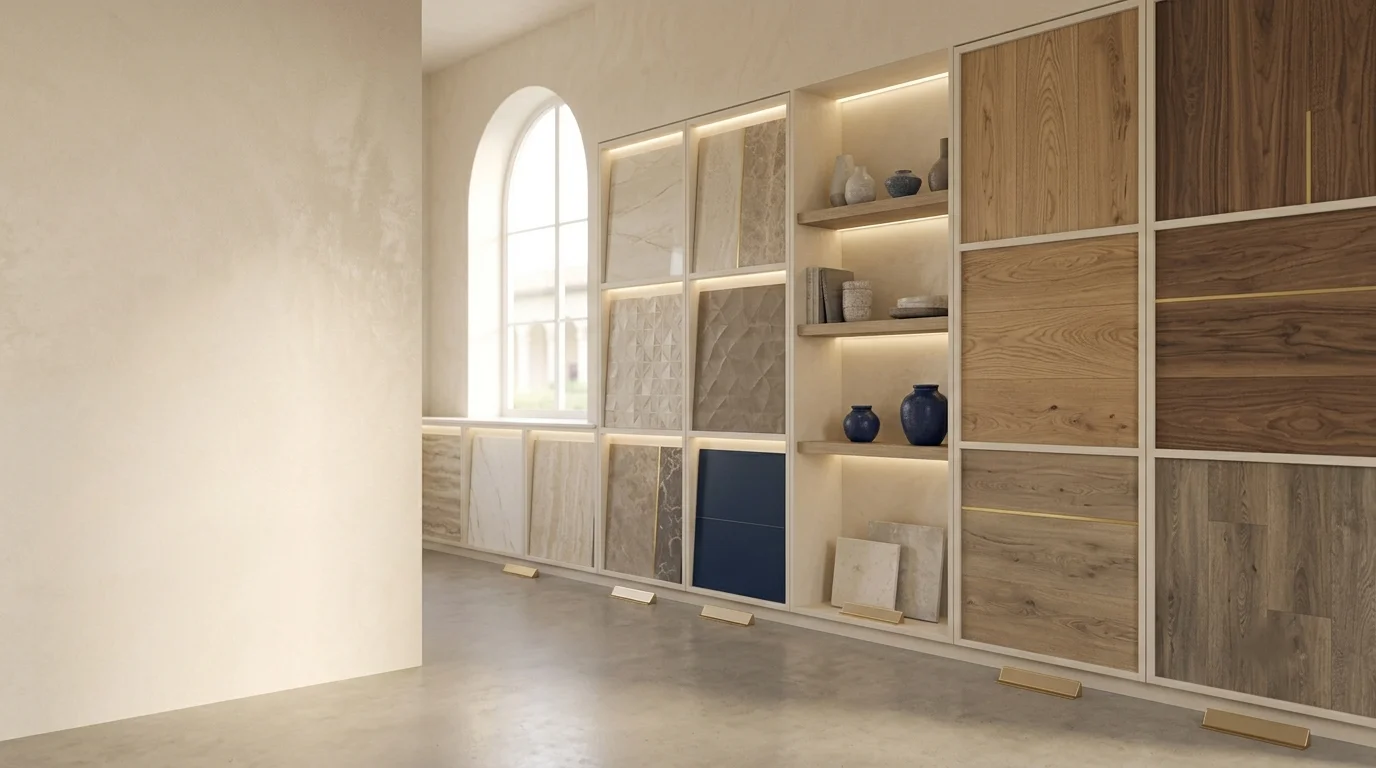
Tile and flooring are impossible to judge from a screen, texture, sheen, and scale only show up in person. At H&C Kitchen & Bath in Derwood, MD, we display tile, hardwood, and luxury vinyl options at full scale so you can see how they read in gallery light. We serve Rockville, Bethesda, Gaithersburg, Silver Spring, Potomac, and the D.C. metro.

Choosing tile and flooring? Compare materials in person at the showroom. Book your visit or call (301) 939-0009.

Keep learning: