Kitchen cabinets cost $100 to $300 per linear foot installed for stock lines, $250 to $650 for semi-custom, and $600 to $1,200 for custom. A typical 20 linear foot kitchen lands between $6,000 and $13,000 in semi-custom. Cabinets are usually 30 percent of a full remodel budget, the largest single line item.
Cabinet pricing confuses people because the industry quotes it three different ways: per linear foot, per box, and per project. Worse, two kitchens quoted at the same price can differ by a decade of lifespan. What you are actually buying is four decisions, and only one of them is the brand name on the door.
What a kitchen costs, by tier
Linear foot means the run of wall the cabinets occupy, counting base and wall cabinets together. A standard galley or L shaped kitchen is 18 to 25 linear feet.
| Tier | Per linear foot, installed | 20 foot kitchen | Lead time |
|---|---|---|---|
| Stock | $100 to $300 | $2,000 to $6,000 | In stock to 2 weeks |
| Semi-custom | $250 to $650 | $5,000 to $13,000 | 4 to 8 weeks |
| Custom | $600 to $1,200+ | $12,000 to $24,000+ | 8 to 16 weeks |
Most Montgomery County kitchens we specify land in semi-custom. Stock works when the layout is standard and the timeline is short. Custom earns its price when the room has odd angles, a nonstandard ceiling height, or a piece of furniture quality millwork is the point.
The four decisions that set the price
1. Box construction, the one you cannot see later
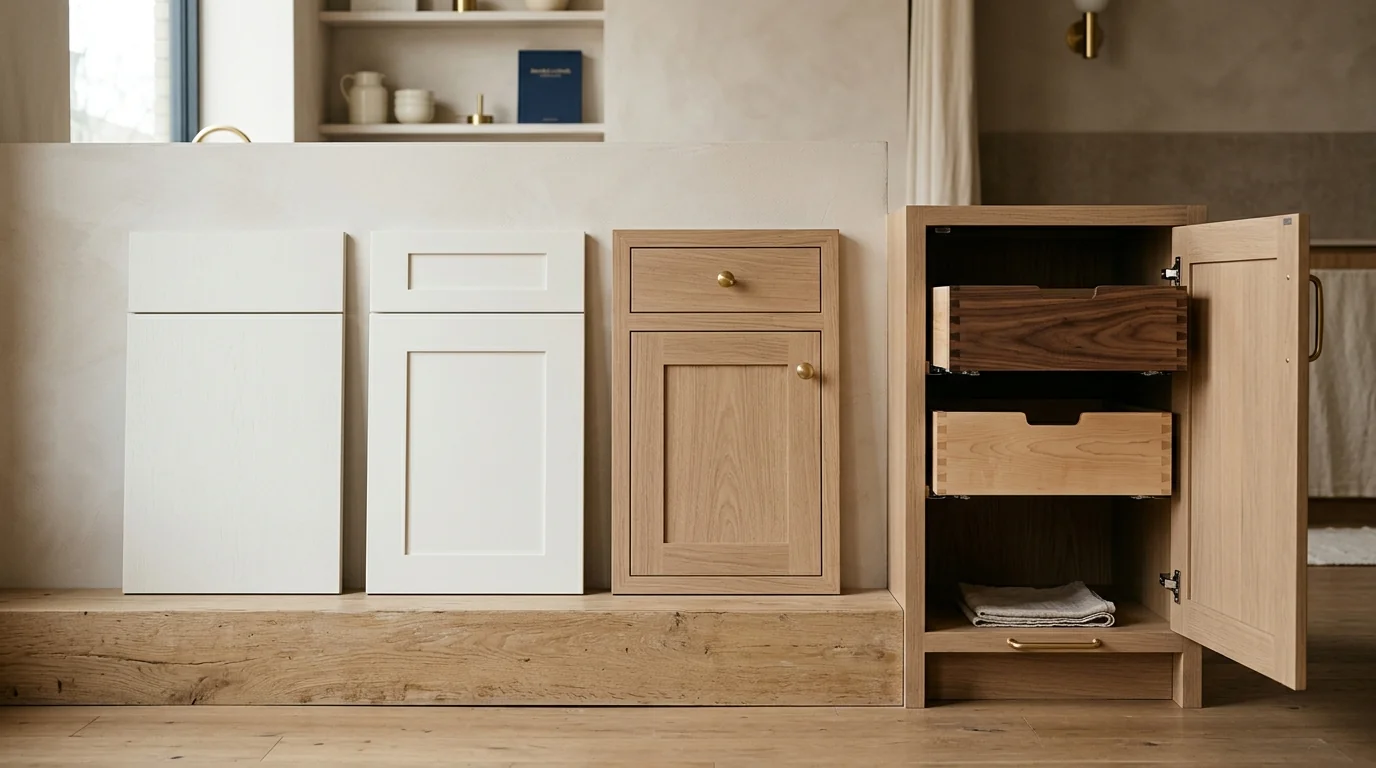
Plywood boxes cost 15 to 25 percent more than particleboard and are the difference between a kitchen that survives a leak and one that swells. Look at the side panel thickness, the drawer box joinery, and whether the back is a full panel or a hanging rail. Dovetailed solid wood drawer boxes with full extension soft close glides are the current standard in semi-custom and are worth insisting on.
2. Door style, priced by how it is made
A flat slab and a five piece shaker are not the same manufacturing operation. Inset doors, where the door sits flush inside the frame rather than over it, add 20 to 35 percent because the tolerances are tighter and the frame has to be perfect.
3. Finish, where painted beats stained on price every time
Painted costs 10 to 20 percent more than stained on the identical box. Paint shows every imperfection, so it requires more prep, more coats and more rejects at the factory. A specialty glaze or a matte conversion varnish adds again.
4. Configuration, the quiet budget killer
Drawer banks cost more than door bases. Every pull out, lazy susan, trash pull out, spice rack and appliance garage is a line item. A kitchen specified with every organizational accessory can run 20 percent over the same kitchen with sensible storage.
What the quote should include and often does not
- Delivery and staging
- Removal and disposal of the old cabinets
- Installation labor, which typically runs $100 to $250 per linear foot on its own
- Filler strips, toe kick, crown and light rail, which are not free
- Scribing and shimming on out of square walls, common in homes built before 1970
A cabinet quote that is only the boxes is not comparable to a quote that includes install. This is the single most common reason two bids look thousands apart when they are actually the same kitchen.
The Maryland factor
Cabinet material prices are national. Installation labor is not. Montgomery County install rates run roughly 15 to 25 percent above national averages, driven by DC metro labor costs. Older housing stock adds real hours: walls that are not plumb and floors that are not level turn a two day install into a four day install.
Where our lines sit
We stock Fabuwood, Forevermark, Cubitac, Medallion and St. Martin, which together span stock through the upper end of semi-custom. Seeing the boxes open, side by side, is the only reliable way to understand what separates a $250 linear foot line from a $500 one. The difference is visible in ten seconds and invisible in a photograph. Compare what we carry on our kitchen cabinets in Maryland page, then come see the boxes.
If the numbers here point you toward a full remodel rather than cabinets alone, our sister company handles the build and can scope the labor side against the same plan.
Frequently asked questions
How much do kitchen cabinets cost for a 10×10 kitchen?
A 10×10 kitchen is roughly 20 linear feet and is the industry’s standard comparison unit. Expect $2,000 to $6,000 in stock cabinets, $5,000 to $13,000 in semi-custom and $12,000 or more in custom, installed.
Are plywood cabinets worth the extra cost?
For base cabinets under a sink or near a dishwasher, yes. Plywood resists moisture and holds fasteners better over time. The 15 to 25 percent premium buys years of service life in exactly the spots that fail first.
Why are painted cabinets more expensive than stained?
Paint requires more surface prep, more coats and tighter quality control because it hides nothing. On the same box from the same manufacturer, painted typically runs 10 to 20 percent above stained.
Is it cheaper to buy cabinets and hire an installer separately?
Usually not, once change orders are counted. When the supplier and the installer are separate, nobody owns the seam between the order and the install, and mismeasures become your problem. See our comparison of a cabinet showroom versus a big box store.
How long do kitchen cabinets take to arrive?
Stock lines ship immediately or within two weeks. Semi-custom runs 4 to 8 weeks. Custom runs 8 to 16 weeks. Order lead time, not installation, is what usually sets a remodel schedule.
Want a real number for your kitchen? Bring your dimensions to our Derwood showroom and we will price the same layout across three cabinet lines so you can see what the money buys. Call (301) 939-0009 or book a showroom visit.