Posted on Leave a comment

Cabinet Showroom vs Big Box Store: Which Should You Actually Use?

Use a cabinet showroom when the kitchen is a full renovation, when the layout is not a simple rectangle, or when you want plywood construction and finish accuracy you can verify by hand. Use a big box store when the job is a straightforward replacement in a standard layout, the budget is tight, and stock sizes fit without modification. The real difference is not quality alone, it is who owns the problem when something is wrong.

Whichever route you take, somebody still has to install it. Coordination between where you buy and who installs is where most kitchens lose weeks, which is why H&C Construction handles the build on projects we supply.

We are a showroom, so read this with that in mind. We have also lost sales to big box stores where the customer made the right call, and we will say where those cases are.

The structural differences

Factor Cabinet showroom Big box store
Box construction Plywood standard on most lines Particleboard common at entry price
Available sizes Semi-custom, 3 inch increments, modifications possible Stock sizes, limited modification
Finish options Broad, including custom color matching Limited palette per line
Door styles Dozens per line A handful
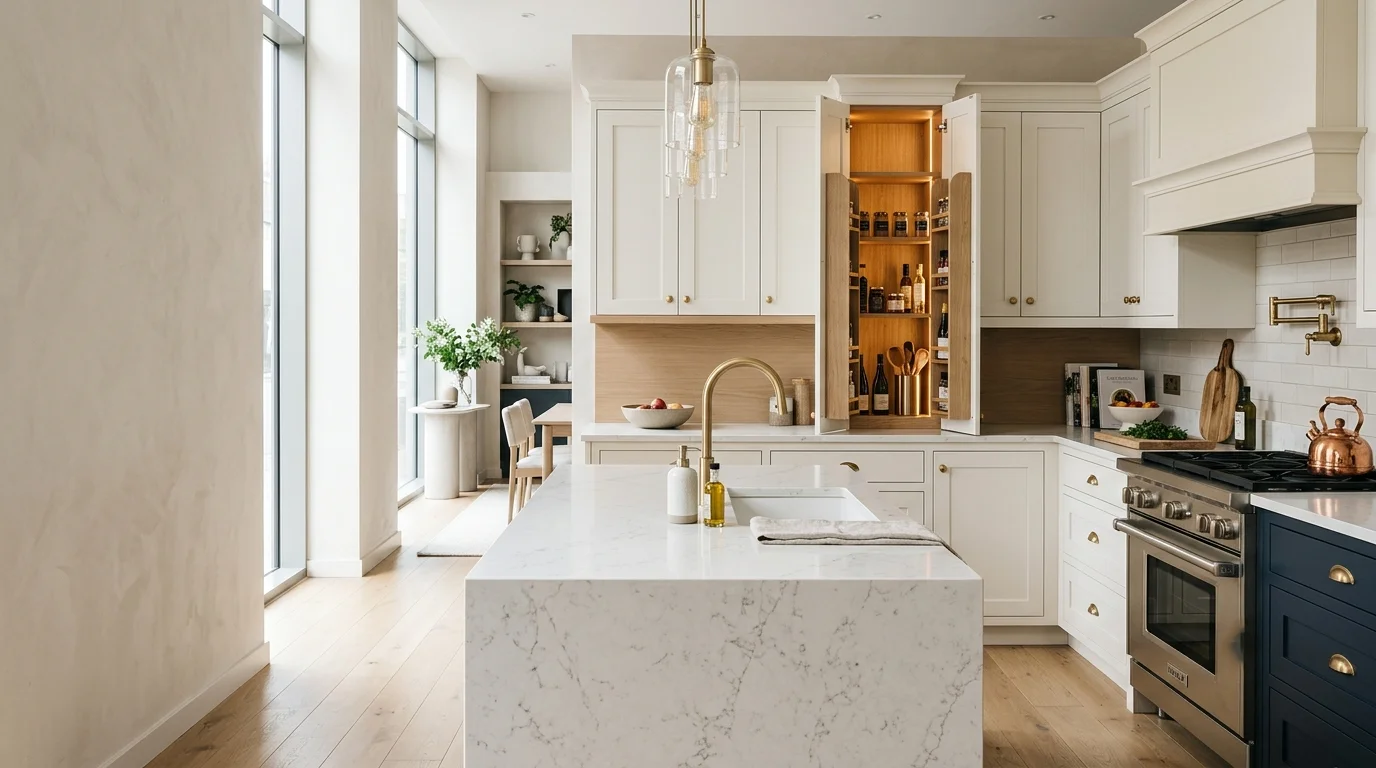
Seeing the actual product Full display kitchens, open the drawers Door samples, partial displays
Design support Specialist who does this daily Varies widely by store and staffing
Lead time 4 to 10 weeks semi-custom, some quick-ship Often faster on stock
Price Higher per linear foot Lower entry point
Order errors Showroom resolves with the manufacturer You often manage it yourself

When the big box store is the right answer

Genuinely, these cases exist:

  • A rental property or a flip where the goal is clean and functional, not durable for fifteen years.
  • A simple galley or L-shaped kitchen where stock sizes fit wall to wall without fillers or modifications.
  • A tight budget where the alternative is not remodeling at all. A functioning particleboard kitchen beats a broken one.
  • You are the contractor. If you can measure, order, verify, and install yourself, you are absorbing the coordination that a showroom otherwise provides.

If you are in one of those cases, take the savings. We would rather tell you that than sell you a kitchen you did not need.

When the showroom pays for itself

The layout is not a clean rectangle

Angled walls, out-of-plumb corners, a peninsula, a bumped-out window, or ceilings that vary by an inch across the run. Stock cabinets in 3 inch increments handle this with filler strips, which look like filler strips. Semi-custom handles it with modified boxes.

Montgomery County housing stock produces this constantly. Homes from the 1940s through 1960s in Bethesda, Silver Spring, and Kensington are rarely square.

You care about what you touch

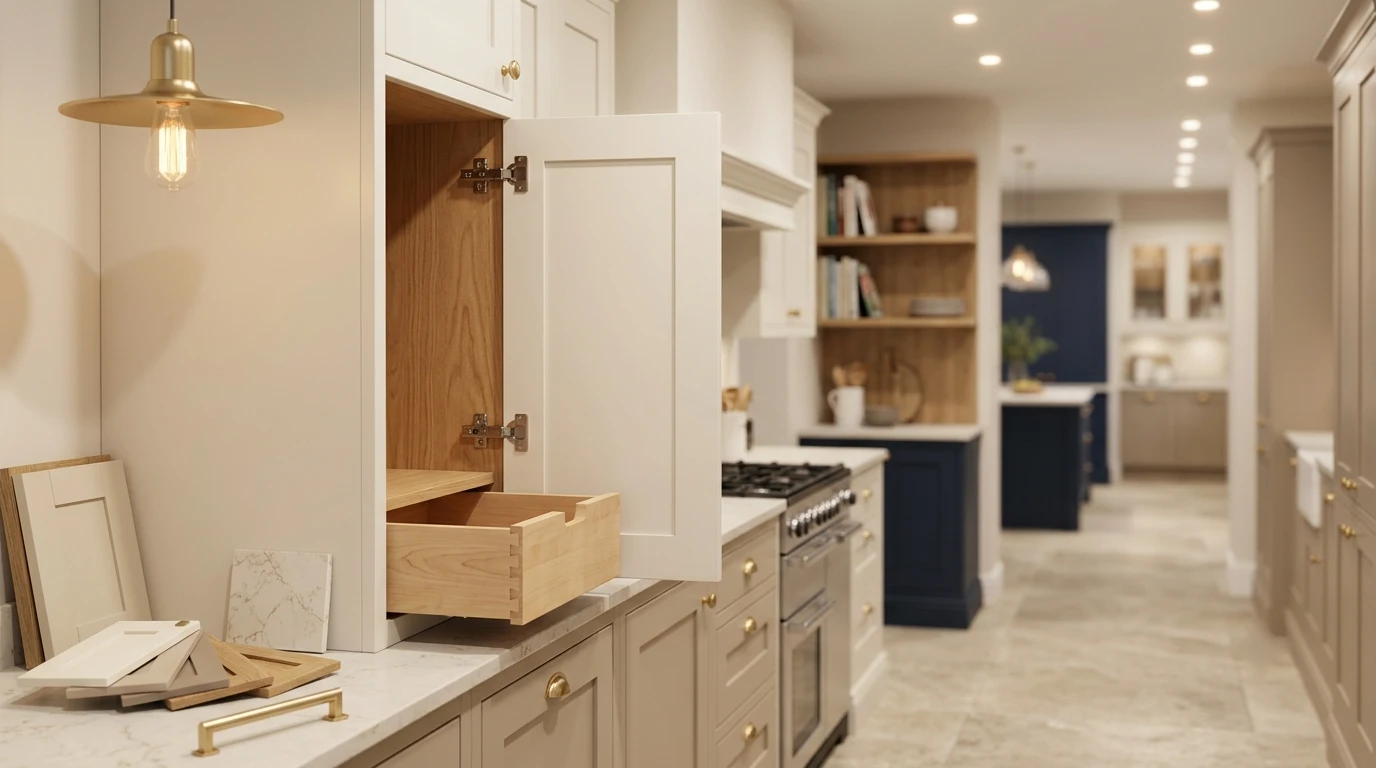
Drawer glide weight, hinge quality, and door alignment are felt every day and are almost impossible to evaluate from a door sample stapled to a display board. In a showroom you open a full drawer bank loaded to weight. That is a different piece of information.

The finish has to be right

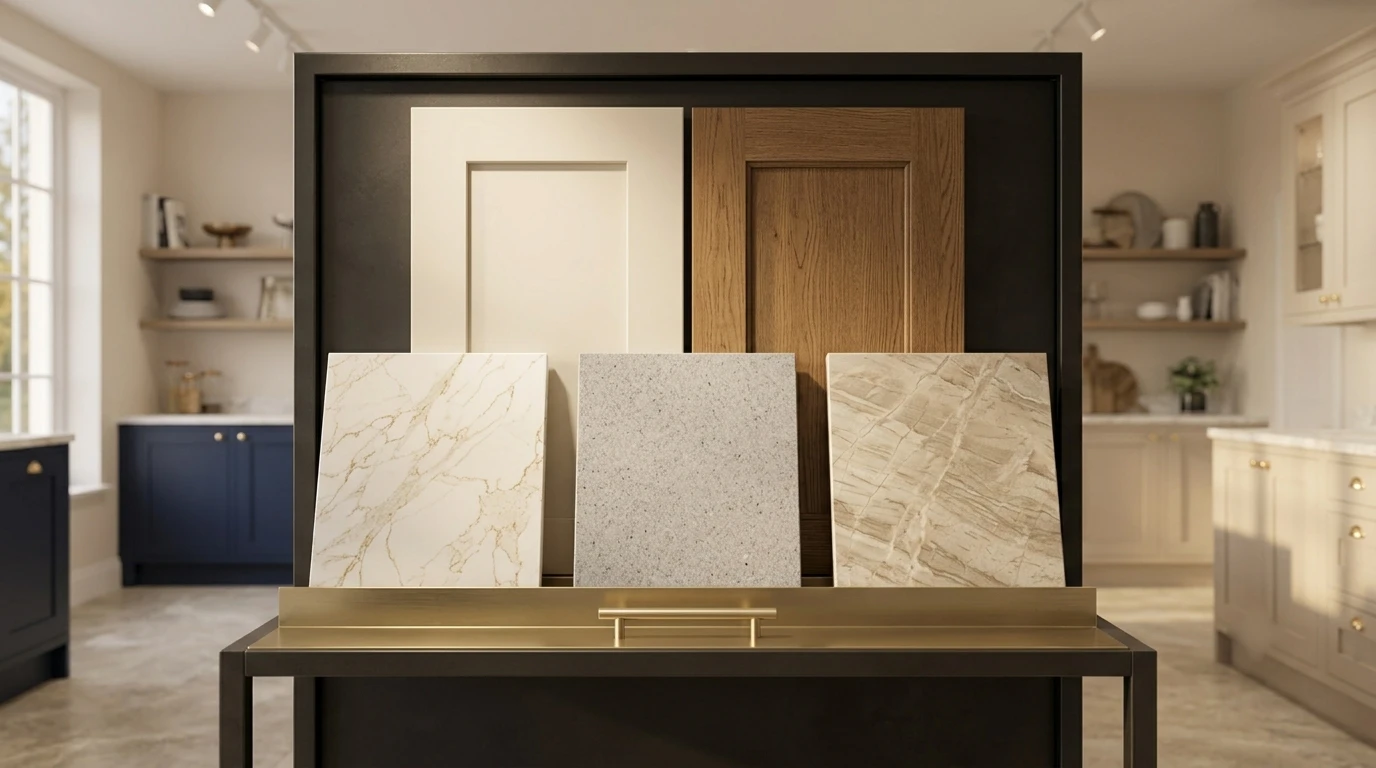
Cabinet finishes shift under different light temperatures. A white that reads warm under 3000K showroom light reads grey under 4000K LED. We keep lit displays specifically so you can check this, because a finish decision made under the wrong light is discovered after installation, when it is unfixable.

Something will go wrong

On a full kitchen, something arrives damaged, mismeasured, or backordered. The question is who chases it. A showroom has an account manager at the manufacturer and places orders weekly. That relationship is most of what you are paying for, and you only notice it when you need it.

What the price difference actually buys

A semi-custom kitchen from a showroom typically runs 30 to 60 percent more per linear foot than an entry stock line. That gap covers, roughly in order of value:

  1. Plywood boxes instead of particleboard. Particleboard fails at the sink base first, when it gets wet. This is the single most common cabinet failure we see.
  2. Full-extension soft-close hardware as standard rather than an upgrade.
  3. Modifications so boxes fit your walls instead of fillers hiding the gap.
  4. Finish range and consistency, including matched accessories and panels.
  5. Order management by someone whose job is that order.

For a comparison of the specific lines we carry and how they differ, see our cabinet brand comparison guide or browse kitchen cabinets in Maryland.

The question that settles it

Who fixes it when the order is wrong?

If your answer is “me, and I am fine with that,” a big box store is a reasonable choice and you should take the savings. If your answer is “I want someone whose name is on this to handle it,” that is what a showroom sells, and the premium is priced against that.

At H&C, that goes one step further, because our sister company H&C Construction installs. When a cabinet arrives damaged, the same organization that ordered it reschedules the crew. Split responsibility between a retailer and an unrelated installer is where kitchens lose weeks.

Frequently asked questions

Are cabinet showroom prices higher than big box stores?

Yes, typically 30 to 60 percent more per linear foot. The difference covers plywood construction rather than particleboard, full-extension soft-close hardware as standard, size modifications, a wider finish range, and order management with the manufacturer.

Is it worth buying kitchen cabinets from a showroom?

It is worth it when the kitchen is a full renovation, when walls are not square, when finish accuracy matters, or when you want someone accountable for order problems. It is not worth it for rentals, flips, or simple layouts where stock sizes fit without modification.

What is the difference between stock and semi-custom cabinets?

Stock cabinets come in fixed sizes, usually 3 inch increments, with limited finishes and no modification. Semi-custom cabinets offer size modifications, a wider range of door styles and finishes, and typically plywood construction. Semi-custom lead times run 4 to 10 weeks versus faster availability on stock.

How can I tell if kitchen cabinets are good quality?

Check the box material, plywood over particleboard, especially at the sink base. Open a loaded drawer and feel the glide. Check that doors align and hinges are adjustable. Look at how drawer boxes are joined, with dovetail construction indicating higher quality than stapled butt joints.

Compare them side by side. Our Derwood showroom has full display kitchens from multiple lines. Call (301) 939-0009 or book a visit.

Posted on Leave a comment

Kitchen Cabinet Buying Guide: Rockville, MD Showroom

Kitchen Cabinet Buying Guide: Rockville, MD Showroom

Kitchen cabinets are the biggest investment in any kitchen remodel, and they are also the hardest to reverse. Pick the right construction, door style, and finish and you will enjoy the room for decades. Pick wrong and you are looking at another full renovation. This guide walks you through everything you need to decide before you buy, and it is written for homeowners across Rockville, Montgomery County, and the Washington, D.C. metro who want to see materials in person before they commit.

Why start with the cabinets

Cabinets define the layout, the budget, and the look of a kitchen. Countertops, tile, and flooring all get selected around them, not the other way around. That is why we always tell visitors to our Derwood showroom: start with cabinetry, then build the rest of the palette around it. A cabinet decision fixes your footprint, your storage plan, and roughly a third of your remodel budget, so it deserves the most research time.

Know your cabinet construction: RTA vs assembled

The first fork in the road is how your cabinets are built and delivered. Ready-to-assemble (RTA) cabinets ship flat and get put together on site. Fully assembled cabinets arrive built. Both have a place, but the trade-offs matter for a Maryland remodel. RTA lines can save money and are a legitimate option for rental properties and quick flips. Assembled cabinets cut down install time, reduce the risk of assembly errors, and often carry better warranties. We stock both in the showroom, so you can feel the difference in hinge feel, drawer glide, and panel thickness before you decide. Read our RTA vs assembled cabinet planning guide for the full breakdown.

Door styles: what the profile says about your kitchen

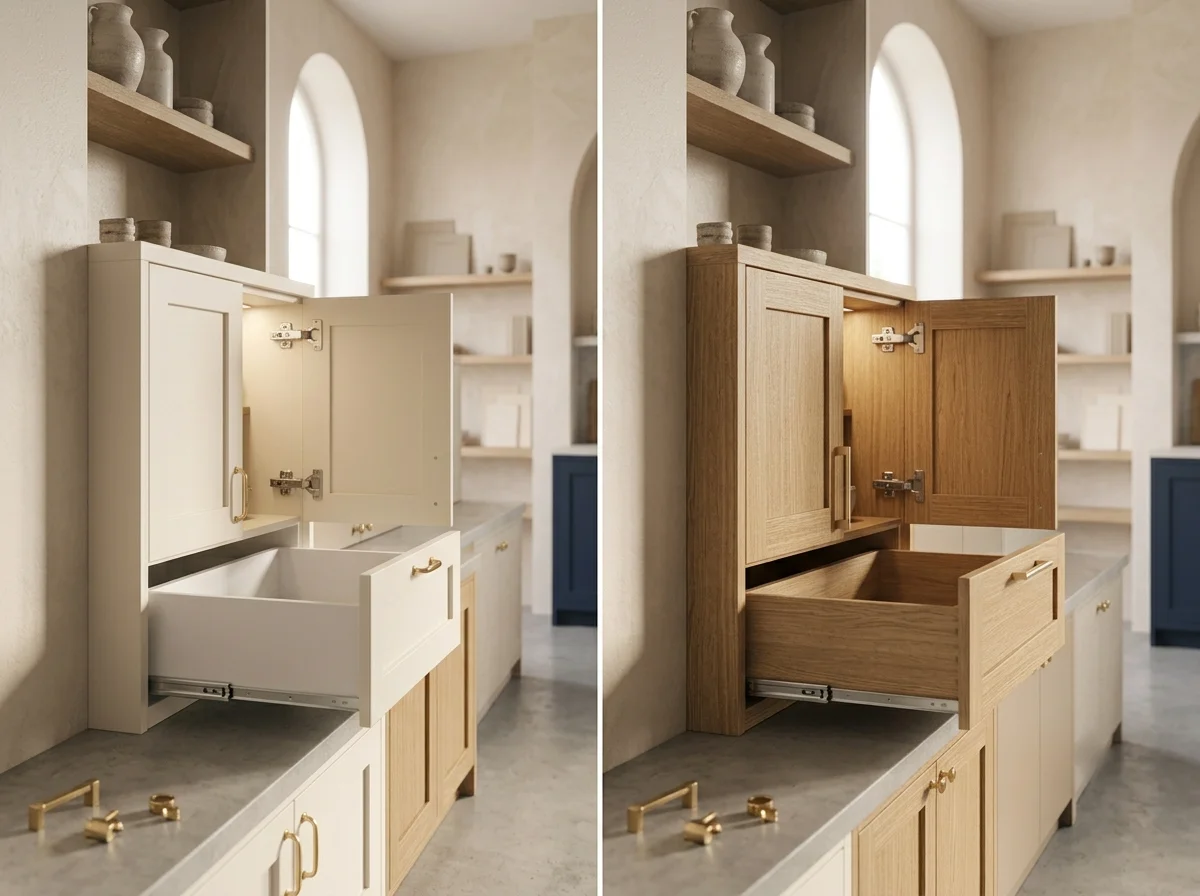
Door style is the personality of the room. The most requested profile in our showroom is the shaker door, a clean, recessed panel that fits both traditional and transitional kitchens. If you want a sleeker, flat look, modern slab doors are a strong fit for contemporary homes. Full-overlay doors cover the cabinet frame for a seamless, furniture-like appearance; inset doors sit flush inside the frame for a more traditional, built-in feel. The right choice depends on your home’s architecture and how much visual texture you want. Compare the details in our shaker vs modern cabinet doors guide.

Materials and finishes that hold up

Cabinet boxes are typically plywood, MDF, or particleboard. Plywood is the most durable and the best choice for full-height pantry units and heavy-use kitchens. Thermofoil wraps are easy to clean and budget-friendly, while painted and stained finishes give you the premium look most homeowners want. On finishes, think about daily life: light colors open up a room but show wear in high-traffic homes, while matte finishes hide fingerprints better than high-gloss. Our cabinet finish durability guide explains how each finish ages so you can match one to your household.

Brands we stock in the Rockville showroom

You should never buy cabinets without knowing the brand and the warranty behind them. At H&C Kitchen & Bath we spec lines builders trust: Forevermark, Fabuwood, Medallion, St. Martin, CNC, Tribeca, Crestwood, Nations, Revola, and Evoke / R.D. Henry. These are distributor-backed lines with ready-to-spec SKUs, which means consistent pricing, real lead times, and support if anything goes wrong, exactly what you will not get buying on the open market alone. You can compare several of these brands side by side on our showroom floor and get honest guidance on which one fits your project and budget. See how the top lines stack up in our cabinet brand comparison guide.

How much should kitchen cabinets cost?

Expect cabinets to run 30% to 45% of a full kitchen remodel. In the D.C. metro, a mid-range kitchen cabinet package typically lands between $15,000 and $30,000 installed, and premium lines push higher. The number depends on lineal footage, door style, finish, and hardware. What matters more than the sticker price is what is included: soft-close hardware, dovetail drawers, plywood boxes, and warranty coverage all change the real value of a quote. Bring your measurements or a rough layout to the showroom and we will help you estimate scope honestly, with no pressure to oversize your order.

How to plan before you visit

A productive showroom visit starts before you walk in. Do this first:

  • [ ] Measure your kitchen, rough ceiling-to-floor and wall lengths are enough to start
  • [ ] Save 5 to 10 kitchen photos you actually like (not dream kitchens)
  • [ ] Note your must-haves: pull-outs, lazy Susans, soft-close, drawer count
  • [ ] Set a budget range before you fall in love with a finish
  • [ ] Decide who installs: your contractor, or a crew we coordinate

The H&C showroom advantage

You can research cabinets for weeks online, but nothing replaces touching the hardware and seeing finishes at full scale. At our showroom at 17620 Redland Rd Ste A, Derwood, MD 20855, you can walk materials with a specialist, compare cabinet lines side by side, and document your selections so your quote and order stay aligned with your decisions. We serve Rockville, Bethesda, Gaithersburg, Silver Spring, Potomac, and the greater D.C. metro, and we work with homeowners and contractors alike.

Ready to plan your kitchen cabinets? Book a free showroom visit or consultation and bring your measurements. Tell us about your project or call (301) 939-0009.

Keep learning:

Posted on Leave a comment

Forevermark vs Fabuwood: Which Cabinet Line Is Right?

Forevermark vs Fabuwood: Which Cabinet Line Is Right?

Forevermark and Fabuwood are two of the most popular cabinet lines we stock, and for good reason: both deliver strong value, reliable lead times, and a finish palette that covers most kitchens. But they are not the same line, and the right choice depends on your project. Here is how to decide.

Positioning at a glance

Forevermark is built as a dependable value line, broad style coverage, solid construction, and consistent pricing that makes it a favorite for whole kitchens and renovation programs. Fabuwood is known for plywood construction, soft-close hardware as standard, and one of the widest finish and door selections in its price band. Both are distributor-backed, which is exactly what you want behind a twenty-year purchase.

Construction and hardware

The honest way to compare any two lines is on the spec sheet and the showroom floor:

  • Box material, both offer plywood construction on key lines; confirm the spec for the specific series you price
  • Drawers, look for full-extension soft-close glides and dovetail-style joints
  • Hinges, soft-close hinges change the feel of every door you open
  • Finish, compare the paint system and the number of color options

Bring this checklist when you visit and ask us to show you the difference on real boxes, hinge weight and drawer glide tell you more than a brochure.

Finish and style coverage

Fabuwood is famous for finish variety, which matters if you have a specific color in mind or want a trendy two-tone look. Forevermark covers the essentials well and keeps the catalog focused, which speeds up decision-making and keeps pricing predictable. If you know exactly what you want, Forevermark gets you there efficiently. If you want to explore, Fabuwood gives you more palette to play with.

Lead times and availability

In the D.C. metro, lead time is part of the decision. Both lines generally ship on reliable schedules, but availability shifts with demand. When you order through a showroom, not the open market, you get realistic dates up front and a coordinator who keeps ordering and shipping aligned through delivery. Ask about current lead times for the exact series and finish you want; stock finishes always move faster.

Budget considerations

Forevermark tends to land at a slightly friendlier price point for equivalent scope, which makes it a strong pick for budget-conscious whole-kitchen remodels. Fabuwood’s construction and finish breadth often justify its position for homeowners who want more color and door options without jumping to premium pricing. Both beat generic open-market lines on support and warranty.

The honest recommendation

  • Choose Forevermark if you want dependable value, predictable pricing, and a clean path from selection to order
  • Choose Fabuwood if you want a wider finish palette and soft-close, plywood-built construction as your priority
  • Visit the showroom before you decide, the right line is the one whose hardware feels right to you

Compare both at the showroom

At H&C Kitchen & Bath in Derwood, MD, Forevermark and Fabuwood are staged side by side so you can open the doors, pull the drawers, and compare finishes at full scale. We serve Rockville, Bethesda, Gaithersburg, Silver Spring, Potomac, and the D.C. metro, and we work with homeowners and contractors.

Not sure between Forevermark and Fabuwood? Compare them in person. Book your showroom visit or call (301) 939-0009.

Keep learning: