
Posted on Leave a comment

Kitchen Renovation Cost in Maryland: Materials vs Labor, Line by Line

A mid-range kitchen renovation in Montgomery County, Maryland typically costs $55,000 to $95,000 in 2026. Cabinets consume about 30 percent of that budget, labor about 22 percent, and countertops about 11 percent. A cosmetic refresh runs $25,000 to $45,000. A full custom renovation with structural changes runs $100,000 to $180,000 or more.

Want these numbers priced for your kitchen? The remodel itself is executed by our sister company, H&C Construction, so the materials estimate and the labor estimate come from the same plan. You can request a free estimate to get started.

Most cost articles are written by people who sell one half of the job. Contractors quote labor and guess at materials. Retailers quote materials and wave at labor. H&C Kitchen & Bath sits on both sides: we are a Derwood showroom that supplies cabinets, countertops, tile, and flooring, and our sister company H&C Construction executes the remodel. The numbers below come from seeing both invoices on the same project.

The three budget tiers, and what actually separates them

Tier Range What you get What stays
Cosmetic refresh $25,000 to $45,000 Cabinet refacing or new doors, new countertops, backsplash, hardware, paint, lighting Layout, boxes, plumbing, electrical
Mid-range full $55,000 to $95,000 New semi-custom cabinets, quartz or granite, new flooring, appliances, fixtures, some electrical Walls, window and door openings, main plumbing stacks
Upscale or custom $100,000 to $180,000+ Custom cabinetry, premium stone, moved walls, relocated plumbing, new windows, high-end appliances Foundation

The jump from tier one to tier two is not luxury. It is whether you replace the cabinet boxes. Once boxes come out, countertops, backsplash, flooring, and often electrical come with them. That single decision roughly doubles the project.

The jump from tier two to tier three is almost always moving something that carries water or weight. Relocating a sink, moving a gas line, or taking out a load-bearing wall adds permits, engineering, and trades. In Montgomery County that also adds review time.

Line by line: where $70,000 actually goes

This is a representative mid-range kitchen of roughly 200 square feet in a Montgomery County home, with semi-custom cabinets and quartz counters.

Line item Typical share Dollar range
Cabinetry 30% $18,000 to $24,000
Labor and installation 22% $14,000 to $18,000
Countertops 11% $6,500 to $9,500
Appliances 12% $7,000 to $12,000
Flooring 7% $4,000 to $6,500
Plumbing and electrical 7% $4,000 to $6,000
Lighting and fixtures 4% $2,000 to $3,500
Backsplash and tile 3% $1,500 to $3,000
Permits, design, contingency 4% $2,500 to $4,500

Two of these deserve attention because they are where budgets actually break.

Cabinetry is not one price, it is four decisions

Cabinet cost is driven by construction, door style, finish, and configuration, roughly in that order.

  • Construction. Plywood box versus particleboard changes cost by 15 to 25 percent and changes lifespan by a decade. Full-overlay versus partial-overlay changes both look and price.
  • Door style. A flat slab and a five-piece shaker cost differently to manufacture. Inset doors, where the door sits flush inside the frame, can add 20 to 35 percent over overlay.
  • Finish. Painted costs more than stained on the same box, typically 10 to 20 percent, because painted finishes show every imperfection and require more prep.
  • Configuration. Drawer banks cost more than door bases. Every pull-out, lazy susan, and trash pull-out is a line item.

Lines we stock, including Fabuwood, Forevermark, Cubitac, Medallion, and St. Martin, span this whole range. You can see the boxes side by side at the showroom, which is the only reliable way to understand what you are paying for. Compare options on our kitchen cabinets in Maryland page before you visit.

Labor is priced on complexity, not hours

A common misread: homeowners assume labor scales with kitchen size. It scales with complexity and condition. The same 200 square foot kitchen can carry $12,000 or $22,000 of labor depending on:

  • Whether walls are plumb and floors are level, which older Montgomery County housing stock frequently is not
  • Whether plumbing and electrical stay in place
  • Whether the countertop template requires seams or an unusual overhang
  • Whether demolition uncovers knob-and-tube wiring, galvanized pipe, or asbestos tile, common in homes built before 1978

Homes in Bethesda, Silver Spring, and Kensington built in the 1940s through 1960s reliably produce at least one of these. That is why our estimates carry a contingency line rather than pretending they will not.

What drives cost up that nobody warns you about

Moving the sink. Relocating a sink means new supply lines, new drain, and a vent. In a slab-on-grade home this can mean cutting concrete. Budget $2,500 to $6,000 before finishes.

Load-bearing walls. Opening a kitchen to a family room is the single most requested change we see and the most underbudgeted. Engineering, a beam, temporary support, and permit review typically add $8,000 to $20,000.

Appliance upgrades late in the process. A 36 inch professional range needs different ventilation, a different cabinet opening, and often a dedicated circuit. Changing this after cabinets are ordered means re-ordering cabinets.

Countertop material chosen after cabinet order. Some stones need additional support. Some overhangs need corbels or steel. Deciding the slab first prevents this.

What drives cost down without cheapening the kitchen

  • Keep the plumbing where it is. This is the highest leverage decision in the entire budget.
  • Reface instead of replace when boxes are solid plywood and the layout works. Refacing is genuinely good value when the bones are good and genuinely a waste when they are not.
  • Choose quartz in a simpler pattern. Dramatic veining costs more per slab and often requires slab matching across seams.
  • Spend on what you touch. Hinges, glides, and faucet quality are felt daily. Interior cabinet accessories are frequently over-specified.
  • Buy where material and installation are coordinated. Split responsibility is where change orders are born.

The Maryland factor

Montgomery County costs run roughly 15 to 25 percent above national averages. The drivers are labor rates in the DC metro, permit requirements, and housing stock age.

Permits matter more here than most homeowners expect. In Montgomery County, a kitchen renovation that involves electrical, plumbing, or structural work requires permits, and inspections are scheduled at defined stages. A contractor who suggests skipping permits is creating a problem for your eventual sale, not saving you money. Verify current requirements with the Montgomery County Department of Permitting Services before you finalize a schedule.

Why we can quote both halves

Most showrooms hand you a materials number and send you to find a contractor. Most contractors hand you a labor number and send you to pick materials. The gap between those two conversations is where projects lose money, because nobody owns the seam.

H&C runs both. The showroom in Derwood specifies the materials. H&C Construction executes the work. That means the cabinet order and the install schedule are built against the same plan, and when a slab is delayed the crew calendar moves with it instead of sitting idle on your dime.

If you want a real number for your kitchen, the fastest path is bringing your dimensions and a few photos to the showroom.

Frequently asked questions

How much does a kitchen renovation cost in Maryland?

A mid-range kitchen renovation in Maryland typically costs $55,000 to $95,000 in 2026. Cosmetic refreshes start around $25,000 and custom renovations with structural changes commonly exceed $100,000. Montgomery County projects run 15 to 25 percent above national averages.

What is the most expensive part of a kitchen renovation?

Cabinetry is the largest single line item, typically 30 percent of the total budget, followed by labor at about 22 percent. Together they account for more than half of a typical kitchen renovation.

Is it cheaper to reface or replace kitchen cabinets?

Refacing typically costs 40 to 60 percent of replacement and makes sense when the cabinet boxes are structurally sound plywood and the existing layout works. Replacement is the better value when boxes are particleboard, damaged, or when the layout needs to change.

How long does a kitchen renovation take in Montgomery County?

Plan on 8 to 14 weeks from demolition to completion for a mid-range kitchen, plus 4 to 10 weeks before that for design, selections, and cabinet lead time. Permit review adds time and should be started early.

Do I need a permit for a kitchen remodel in Maryland?

Yes, in most cases. Montgomery County requires permits for kitchen work involving electrical, plumbing, or structural changes. Cosmetic work such as painting, refacing, and countertop replacement generally does not require a permit. Confirm current requirements with the county before scheduling.

Ready for a real number? Bring your kitchen dimensions to our Derwood showroom and we will walk you through cabinet lines, countertop options, and what the install actually involves. Call (301) 939-0009 or book a showroom visit.
Posted on Leave a comment

How Much Does a Kitchen Remodel Cost? A Showroom and Contractor Breakdown

A kitchen remodel costs $25,000 to $180,000. The single biggest cost driver is whether you replace the cabinet boxes: keeping them holds most projects between $25,000 and $45,000, while replacing them puts you at $55,000 or more. The second driver is whether you move plumbing, which typically adds $2,500 to $6,000 plus permit time.

Not sure which tier your kitchen falls into? A walkthrough settles it faster than any calculator, because the answer depends on your cabinet boxes and your plumbing. H&C Construction can scope it and estimate the work.

That range is uselessly wide until you know which tier you are in. This article exists to place you in one, quickly, using the two questions that actually determine the answer.

The two questions that set your budget

Question one: do the cabinet boxes stay or go?

Everything follows from this.

If boxes stay, you are doing a refresh. New doors and drawer fronts, new countertops, new backsplash, hardware, paint, possibly lighting. The plumbing stays. The layout stays. Most of these land between $25,000 and $45,000.

If boxes go, you are doing a renovation. Countertops must come off, the backsplash comes off, flooring usually comes up because the old floor stops at the old cabinet footprint, and electrical typically gets updated to current code. Most of these land between $55,000 and $95,000.

There is no meaningful middle. Once the boxes leave, the connected work follows automatically.

Question two: does anything that carries water or weight move?

Nothing moves: you stay in the range above.

Sink, range, or dishwasher relocates: add $2,500 to $6,000 for plumbing and electrical rough-in, more in slab-on-grade homes where concrete must be cut.

A wall comes out: add $8,000 to $20,000 for engineering, beam, temporary shoring, and permit review. This is the most commonly underestimated line in kitchen remodeling.

Cost by kitchen size

Cost does not scale linearly with square footage, because the expensive elements cluster in the work zone. A galley kitchen and an open kitchen of the same area can differ by 30 percent based on linear feet of cabinetry.

Kitchen size Linear feet of cabinets Refresh Full renovation
Small, under 100 sq ft 10 to 15 $18,000 to $30,000 $38,000 to $58,000
Medium, 100 to 200 sq ft 15 to 25 $25,000 to $45,000 $55,000 to $95,000
Large, 200 to 300 sq ft 25 to 35 $40,000 to $65,000 $85,000 to $140,000
Very large, 300+ sq ft 35+ $60,000+ $120,000 to $180,000+

Measure linear feet, not area. Cabinets are quoted by the box, and boxes sit along walls.

What each tier actually buys

$25,000 to $45,000: the honest refresh

You keep the layout and the boxes. You get new doors, new counters, new backsplash, new hardware, paint, and usually new lighting. Done well, this reads as a new kitchen to anyone who did not live in the old one.

This tier works when the boxes are plywood, the layout functions, and you are not fighting the kitchen daily. It is a poor investment when the layout is the problem, because you will spend $35,000 and still have a kitchen that does not work.

$55,000 to $95,000: the standard full renovation

New semi-custom cabinets, quartz or granite counters, new flooring throughout the kitchen, new appliances, updated electrical, new fixtures and lighting. Layout can change modestly within the existing plumbing footprint.

This is where most Montgomery County kitchens land, and it is where cabinet selection matters most. The spread between an entry semi-custom line and a premium one on the same layout can be $8,000 or more, which is why we recommend seeing the boxes before you decide. Our cabinet comparison guide covers how the lines differ.

$100,000 to $180,000 and up: custom and structural

Custom cabinetry built to your dimensions, premium stone with slab matching, relocated plumbing and gas, removed walls, new windows, professional appliance packages, and often new flooring extending beyond the kitchen for continuity.

At this tier the design phase itself takes months, and the cost of a mistake is high enough that showroom-level material verification stops being optional.

Cost per square foot, and why it misleads

Kitchen remodel cost in the DC metro runs roughly $150 to $350 per square foot, and higher for custom work. That number is useful for a first sanity check and dangerous for planning, because two kitchens with identical square footage can differ by 40 percent based on linear feet of cabinetry, appliance package, and whether plumbing moves.

Use per square foot to test whether a quote is plausible. Use linear feet and a line-item breakdown to actually budget.

Where the money goes

Roughly 52 percent of a full kitchen renovation is cabinets plus labor. Countertops, appliances, and flooring together account for another 30 percent. The remaining 18 percent covers plumbing, electrical, lighting, tile, permits, and contingency. For the detailed line-item table, see our Maryland kitchen renovation cost breakdown.

Getting a number you can trust

A quote that arrives without a site visit is a guess. A quote that arrives without specified material lines is a placeholder. The estimates that hold are the ones where somebody measured the room, opened a wall panel or looked at the electrical panel, and priced named products rather than allowances.

We build estimates against specified products because we stock them. When the quote says a particular cabinet line in a particular finish, that is a real price, not an allowance that gets revised upward after demolition.

Frequently asked questions

How much does a kitchen remodel cost in 2026?

A kitchen remodel costs $25,000 to $180,000 in 2026. Cosmetic refreshes that keep cabinet boxes run $25,000 to $45,000. Full renovations with new cabinets run $55,000 to $95,000. Custom and structural projects run $100,000 to $180,000 or more.

What is a realistic budget for a small kitchen remodel?

A small kitchen under 100 square feet typically costs $18,000 to $30,000 for a refresh and $38,000 to $58,000 for a full renovation with new cabinets. Small kitchens cost less in materials but carry similar fixed costs for plumbing, electrical, and permits.

Why are kitchen remodel quotes so different from each other?

Quotes differ because of scope assumptions and allowances. One quote may assume the layout stays and use generic material allowances, while another prices named cabinet lines and includes electrical updates. Compare quotes only when the specified products and the scope of trades match.

Does a kitchen remodel add value to a home in Maryland?

Kitchen remodels in the DC metro typically recover 60 to 75 percent of cost at resale, with mid-range projects recovering more of their cost than high-end ones. Kitchens that correct a bad layout tend to affect saleability more than kitchens that simply update finishes.

Want your number instead of a range? Bring dimensions and photos to our Derwood showroom. Call (301) 939-0009 or book a visit.

Posted on Leave a comment

Kitchen Remodel Ideas That Survive Daily Use

The kitchen remodel ideas worth your budget are the ones still working in year five: deep drawers instead of lower door cabinets, a work zone with 42 to 48 inches of clearance, quartz on the perimeter, undercabinet lighting on a separate switch, and a single durable flooring run. The ideas we most often get called back to undo are open shelving in cooking zones, dark matte finishes on high-touch surfaces, and trendy backsplash tile with heavy grout lines.

Most of these ideas have a construction cost attached, and some are far cheaper to do while the walls are already open. If you are planning a remodel, it is worth running your list past H&C Construction before the design is locked.

We occupy an unusual position: we sell the materials and, through H&C Construction, we install them. We also get the call three years later. That second call is what informs this list.

Layout ideas that change daily life

Deep drawers instead of lower doors

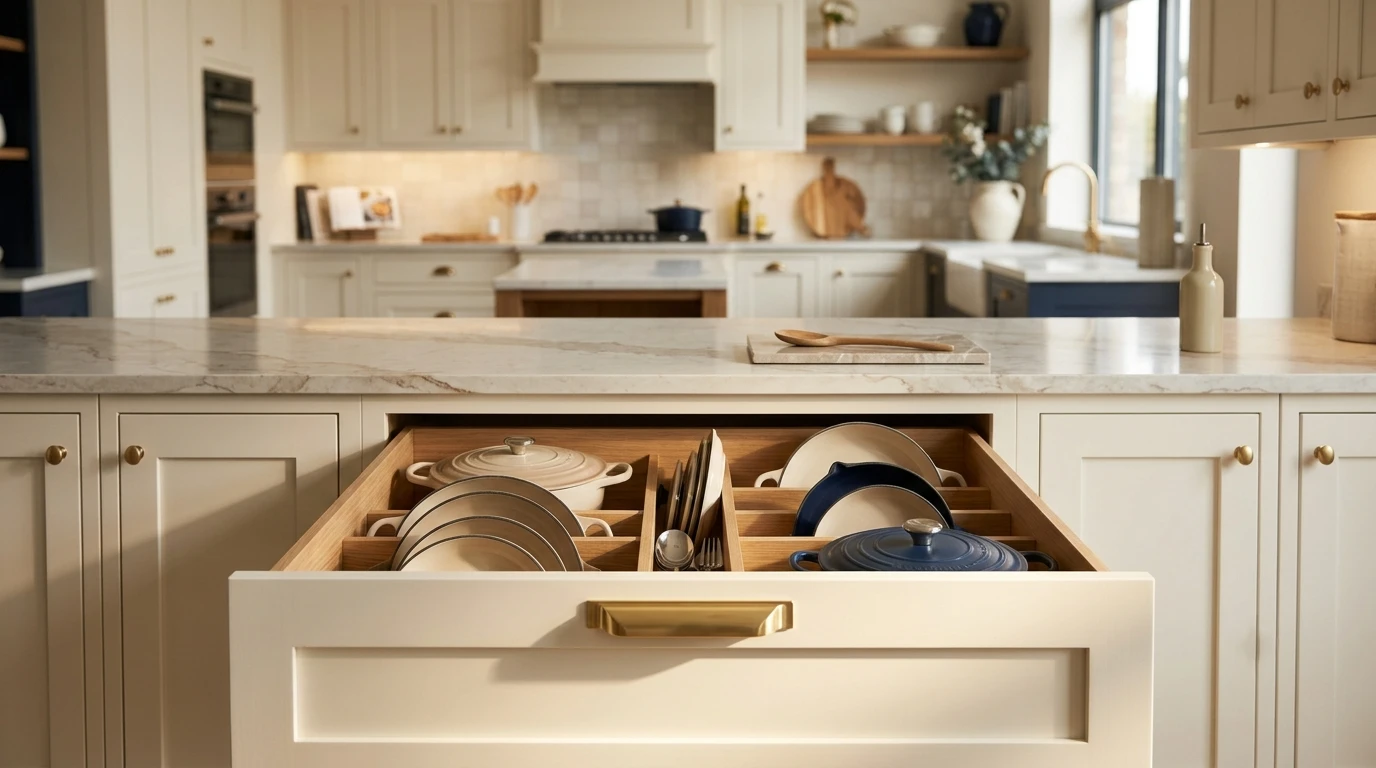
The single highest-satisfaction change we see. A lower cabinet with a door requires kneeling and reaching into darkness. A drawer bank brings everything to you. Cost difference is real, roughly 15 to 25 percent more per box, and it is the upgrade homeowners mention unprompted years later.

Respect the work triangle, but prioritize clearance

The sink, range, and refrigerator triangle still matters, but in practice clearance matters more. Plan 42 inches between opposing runs in a one-cook kitchen and 48 inches if two people cook. Below 36 inches, dishwasher and oven doors collide with traffic.

Put the trash pull-out next to the sink and prep zone

Sounds trivial. It is the accessory homeowners regret placing badly more than any other.

Small kitchens: go vertical and go drawer

For kitchens under 100 square feet, cabinets to the ceiling add real storage and make the room read taller. Skip the soffit. Use a shallow 12 inch deep pantry rather than a deep one you cannot see into. And consider a single-bowl sink, since a divided bowl in a small kitchen means neither side fits a sheet pan.

Open concept: verify before you plan

Removing the wall between kitchen and family room is the most requested layout change in Montgomery County homes. Before designing around it, confirm whether the wall is load-bearing and whether plumbing or HVAC runs through it. That answer changes the budget by $8,000 to $20,000.

Material ideas that hold up

Idea Holds up? Why
Quartz perimeter counters Yes Non-porous, no sealing, consistent slabs
Quartzite on an island Yes, with sealing Natural stone durability, needs maintenance
Marble on a working perimeter Rarely Etches from lemon, wine, vinegar within months
Porcelain tile floor Yes Handles water and traffic, wide format reduces grout
Luxury vinyl plank Yes Warmer and quieter than tile, good in below-grade kitchens
Solid hardwood in a kitchen Conditional Fine away from the sink, risky in a busy family kitchen
Painted cabinets Yes Durable on quality finishes, touch-up is straightforward
Dark matte cabinet finish Often not Shows fingerprints and hand oils on every touch
Open shelving in a cooking zone Usually not Collects grease film, requires constant editing
Small mosaic backsplash tile Conditional Beautiful, but grout lines behind a range hold cooking residue

The pattern: surfaces you touch and surfaces near heat and water punish trendy choices. Spend your visual risk budget on the island, the hood, the lighting, and the hardware, which are all replaceable or cleanable.

Lighting ideas that get overlooked

Lighting is the cheapest high-impact line in a kitchen and the one most often left as an afterthought.

  • Undercabinet lighting on its own switch. Task light where you actually cut. This is non-negotiable in a working kitchen.
  • Three layers. Ambient, task, and accent. A single ceiling fixture makes an expensive kitchen look cheap.
  • Dimmers on everything. A kitchen at 7am and at 9pm are different rooms.
  • Check color temperature. 2700K to 3000K reads warm and flatters wood and stone. 4000K and above reads clinical and makes warm finishes look grey.

We keep lit displays in the Derwood showroom specifically because cabinet and countertop finishes shift dramatically under different color temperatures. A finish chosen under showroom light and installed under 4000K LED can look like a different product.

Storage ideas worth the money, and ones that are not

Worth it: drawer dividers for utensils, a pull-out next to the range for oil and spices, deep drawer inserts for pots, a dedicated sheet pan and cutting board vertical divider, soft-close on everything.

Frequently over-specified: corner lazy susans in kitchens that have a better corner solution, appliance garages that become clutter, spice pull-outs so narrow only one jar size fits, and specialty inserts sized to a product line you will stop buying.

The test: will you reorganize your life around this insert, or does it fit how you already cook?

Ideas that are worth doing now because you cannot do them later

Some choices are effectively permanent once the walls close.

  1. Electrical capacity and outlet placement. Adding a circuit later means opening walls.
  2. Plumbing rough-in location. Even if you are not installing a pot filler now, roughing in is cheap while the wall is open.
  3. Ventilation ducted to the exterior. A recirculating hood does not remove moisture or grease from the house. Ducting later is invasive.
  4. Blocking in walls for future items. Cheap now, impossible later.
  5. Under-island outlets and appliance wiring. Code requirements exist and retrofitting a finished island is ugly.

Where to see these decisions in person

Every recommendation above is a tradeoff, and photos flatten tradeoffs. Finish sheen, drawer glide weight, stone veining at full slab scale, and grout color against tile are all decisions that go badly from a screen. Our showroom visit guide covers how to use a visit efficiently, and you can browse kitchen cabinets in Maryland and countertops in Maryland before you come.

Frequently asked questions

What kitchen remodel ideas add the most value?

Layout corrections that improve function add the most value, followed by quality cabinetry, durable countertops, and good lighting. Cosmetic trends add the least and date the fastest. Buyers respond to a kitchen that works more than to a kitchen that is fashionable.

What are good small kitchen remodel ideas?

Take cabinets to the ceiling, replace lower door cabinets with deep drawers, use a single-bowl sink, choose a shallow pantry over a deep one, and keep flooring continuous with adjacent rooms to make the space read larger. Avoid heavy upper cabinetry on every wall.

Is open shelving a good idea in a kitchen?

Open shelving works in low-traffic zones and away from cooking. Near a range it collects grease film and requires constant tidying. Most homeowners who install it in a cooking zone convert back to closed cabinets within a few years.

What kitchen finishes date the fastest?

High-contrast trend combinations, very dark matte cabinet finishes on high-touch surfaces, small mosaic backsplashes with heavy grout lines, and highly specific hardware styles date fastest. Simple door profiles, neutral stone, and quality hardware age well.

Want to test these ideas against real materials? Visit our Derwood showroom. Call (301) 939-0009 or book a visit.