
Posted on Leave a comment

Bathroom Vanity Installation Cost: Vanity, Top, Plumbing and Labor

Bathroom vanity installation costs $400 to $1,600 in labor for a standard replacement, plus $300 to $3,500 for the vanity and top. A like for like swap in the same footprint is a half day job. Changing the width, going to a floating vanity, or moving the supply and drain lines is what pushes the total past $2,500.

The labor number surprises people because a vanity looks like furniture. It is not. It is a plumbing fixture with a cabinet around it, and the price is set by what happens behind it.

What the job costs, by scenario

Scenario Labor Total with vanity and top
Like for like swap, same width $400 to $700 $700 to $2,500
New width, same wall, plumbing stays $600 to $1,100 $1,200 to $4,000
Floating or wall mounted vanity $800 to $1,600 $1,800 to $5,500
Single to double sink conversion $1,200 to $2,500 $2,500 to $7,000
Vanity moved to a different wall $2,000 to $4,500 $3,500 to $9,000

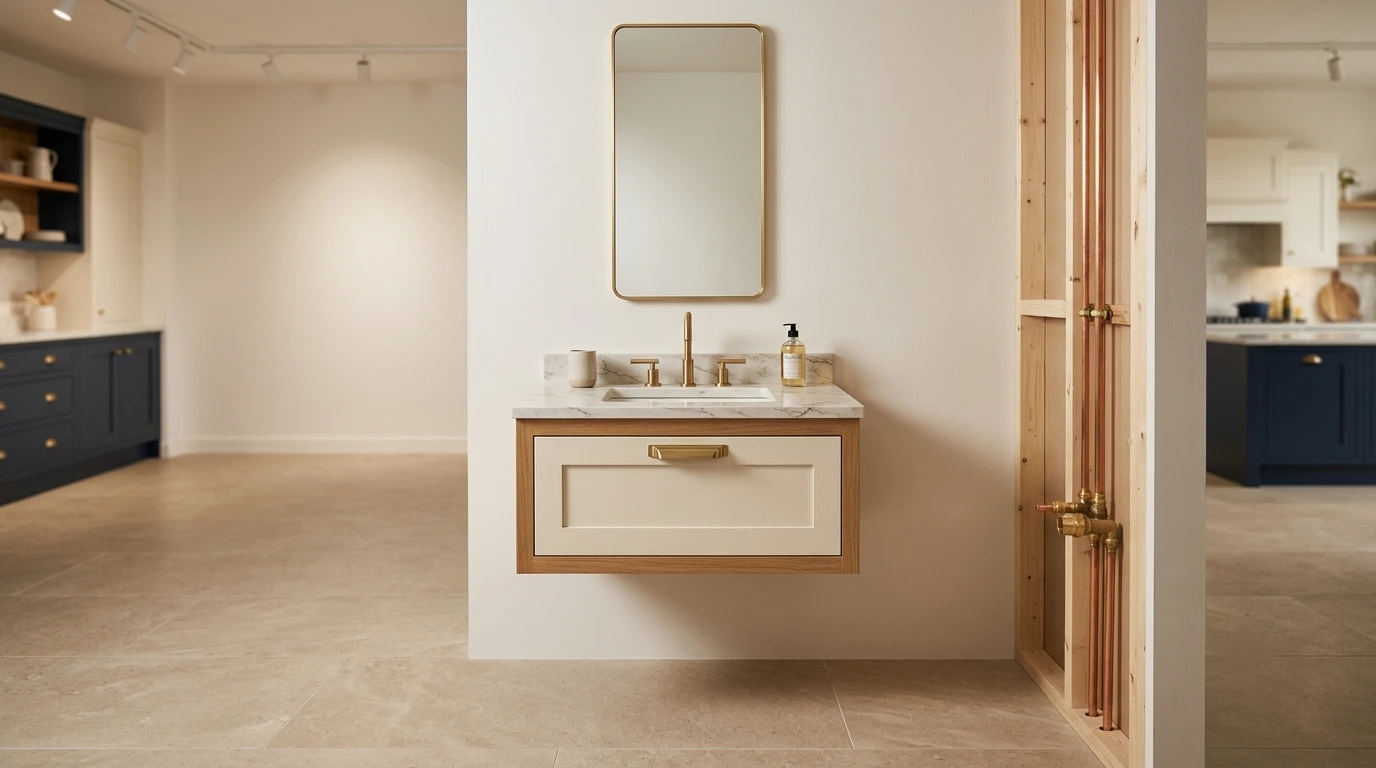
The jump between rows one and three is not the vanity. It is blocking inside the wall. A floating vanity has to hang off framing that can carry the load plus a person leaning on it, which means opening the wall, adding blocking and closing it back up.

Where the money actually goes

The vanity. Entry level ready to assemble units start around $300. Solid wood construction with dovetailed drawers and soft close hardware sits in the $800 to $2,000 range. Custom or premium lines run higher.

The top. A cultured marble integrated top is the budget option. Quartz and granite tops run $300 to $1,200 for a standard single vanity, more for a double. Undermount sinks cost more to fabricate than drop ins because the cutout is polished.

The faucet and drain. A new faucet is almost always worth doing at the same time, because the labor is already there. Reusing an old faucet on a new vanity is the classic false economy: the finish rarely matches and the supply lines are the wrong length anyway.

The wall behind it. Older vanities frequently hide unpainted drywall, tile that stopped at the old vanity’s edge, or a patch of damage from a slow supply leak. Budget for the possibility.

What turns a half day into three days

  • Shutoff valves that are corroded and will not close, which means shutting off the house
  • Galvanized supply lines, common in Montgomery County homes built before 1960
  • A drain that sits too high or too low for the new cabinet’s interior
  • Tile that runs under the old vanity and stops, leaving a bare strip
  • No blocking in the wall for a floating unit

None of these are exotic. On homes from the 1950s and 1960s in Silver Spring, Bethesda and Kensington, at least one of them shows up regularly.

Choosing a size that fits the room, not the picture

Standard vanity widths are 24, 30, 36, 48 and 60 inches. Two rules save more regret than any style decision:

  • Leave at least 30 inches of clear floor space in front of the vanity, and check that the door still swings
  • On a double vanity, 60 inches is the practical minimum, and each sink still ends up with modest counter space. If the room only allows 60 inches, a single sink with a long run of counter is usually the better daily experience

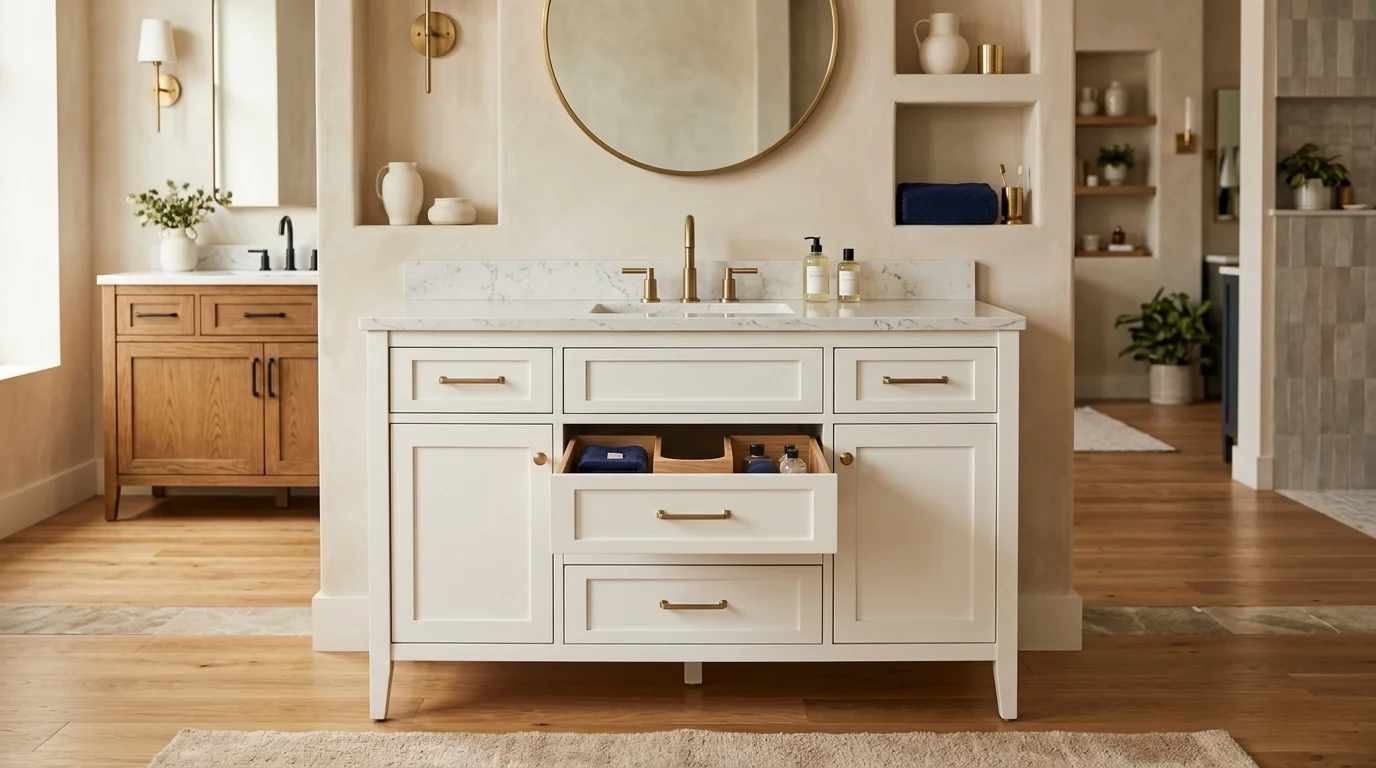
We carry Hardware Resources and Fabuwood vanities across these widths, and the showroom has them installed rather than stacked, which is the only way to judge drawer depth against a plumbing trap. See what we stock on our bathroom vanities in Maryland page.

If the vanity is part of a larger bath project, the full bathroom remodel cost breakdown sets expectations for the rest, and our sister company can price the plumbing and tile work.

Frequently asked questions

How much does it cost to install a bathroom vanity?

Labor runs $400 to $1,600 depending on whether the plumbing stays put. A like for like replacement in the same footprint is at the low end. A floating vanity or a single to double conversion is at the high end.

How long does it take to replace a bathroom vanity?

A straight swap is three to five hours. Changing the width, converting to a double sink, or wall mounting the unit turns it into a one to three day job because of plumbing and wall work.

Is a floating vanity more expensive to install?

Yes, typically $300 to $700 more in labor, because the wall has to be opened to add blocking that carries the cabinet plus load. The payoff is easier floor cleaning and a larger visual sense of the room.

Do I need a permit to replace a bathroom vanity?

A like for like replacement generally does not require a permit. Moving supply or drain lines usually does. Confirm current requirements with the Montgomery County Department of Permitting Services before work starts.

Should I replace the faucet at the same time?

Almost always. The labor is already on site, the supply lines are already disconnected, and matching an old faucet finish to a new top is harder than it sounds.

Bring the room dimensions. We will show you 24 through 60 inch vanities installed, with the drawer interiors open, so you can see what a plumbing trap actually costs you in storage. Call (301) 939-0009 or book a showroom visit.
Posted on Leave a comment

Cost to Add a Bathroom: What It Really Takes

Adding a bathroom costs $15,000 to $60,000. Converting existing interior space near an existing plumbing stack runs $15,000 to $30,000. A basement bathroom requiring a sewage ejector pump runs $20,000 to $40,000. A bathroom in an addition, or one far from existing drain lines, runs $35,000 to $60,000 or more. Fixture selection changes this range far less than plumbing distance does.

Before you choose a vanity, find out where your drain and vent are. That single answer moves the budget more than every finish decision combined, and it takes a site visit to establish. Have H&C Construction check your plumbing first.

Homeowners usually start this project by choosing a vanity. The vanity is close to irrelevant to the cost. What matters is where the nearest drain and vent are, and whether gravity works in your favor.

The one factor that sets the price

Water arrives under pressure and can be routed almost anywhere cheaply. Waste leaves by gravity and must be vented. That asymmetry is the entire cost story.

Scenario Plumbing cost Total project
Adjacent to an existing stack, same floor $2,000 to $4,500 $15,000 to $30,000
Same floor, 15+ feet from stack $4,000 to $8,000 $22,000 to $38,000
Basement, gravity drain available $4,000 to $9,000 $20,000 to $35,000
Basement, ejector pump required $6,000 to $12,000 $25,000 to $40,000
New addition, new stack and connection $10,000 to $20,000 $35,000 to $60,000+

If you have flexibility about where the bathroom goes, moving it ten feet toward an existing stack can save more than every finish decision combined.

Basement bathrooms in Maryland homes

This is the most common bathroom addition we see in Montgomery County, and it has a specific fork in the road.

If your basement floor is above the municipal sewer line, gravity drainage works. You cut the slab, run drain and vent, and connect. Cheaper and more reliable.

If it is below, you need a sewage ejector pump in a sealed basin, which requires a dedicated circuit, a vent, and periodic maintenance. Add $3,000 to $6,000 and accept that a mechanical component now sits between your bathroom and the sewer.

An alternative is an upflush macerating system, which avoids cutting concrete. It is faster and less invasive but limits fixture placement and carries its own maintenance profile. It makes sense when slab cutting is impractical, not as a default.

Many homes in Silver Spring, Wheaton, and Takoma Park have basements that sit close to the line. A plumber can determine which side you are on with an invert elevation check before you design anything.

The rest of the budget

Once plumbing is settled, the remaining costs are predictable.

Line item Range
Framing and drywall $2,000 to $5,000
Electrical, lighting, exhaust, GFCI $1,800 to $3,500
Waterproofing and substrate $900 to $1,800
Tile, materials and labor $3,000 to $7,000
Vanity, top, faucet $1,200 to $4,000
Toilet and shower fixtures $900 to $2,500
Shower glass $1,200 to $3,000
Door, trim, paint $800 to $1,800
Permits and inspections $500 to $1,500

Space requirements that constrain the plan

Before designing, confirm the space actually works. Typical minimums:

  • Half bath: roughly 18 to 20 square feet, with 30 inches of clear width minimum
  • Full bath with shower: roughly 35 to 40 square feet
  • Toilet clearance: commonly 15 inches from centerline to any wall or fixture, and 21 inches of clear space in front
  • Shower: 30 by 30 inches is a common minimum, though 36 by 36 is far more usable
  • Door swing: must not collide with a fixture

These are general planning figures. Confirm against the code edition currently enforced in your jurisdiction, because minimums and interpretations vary.

Permits and resale

A bathroom added without permits is a problem at sale, not a savings. Appraisers and buyers ask, and unpermitted plumbing can complicate financing or trigger a demand to open walls for inspection.

In Montgomery County, adding a bathroom requires plumbing, electrical, and often building permits, with inspections at rough-in and final. Confirm requirements with the Montgomery County Department of Permitting Services before work begins.

Done properly, an added bathroom is one of the stronger value adds in a home, particularly a home with three or more bedrooms and only one full bath.

Frequently asked questions

How much does it cost to add a bathroom to a house?

Adding a bathroom costs $15,000 to $60,000. Converting existing space near a plumbing stack costs $15,000 to $30,000. A basement bathroom needing an ejector pump costs $25,000 to $40,000. A bathroom in a new addition costs $35,000 to $60,000 or more.

How much does it cost to add a bathroom in a basement?

A basement bathroom costs $20,000 to $40,000. The deciding factor is whether the basement floor sits above the sewer line, allowing gravity drainage, or below it, requiring a sewage ejector pump that adds $3,000 to $6,000 plus a dedicated circuit and ongoing maintenance.

Is it cheaper to add a bathroom near existing plumbing?

Yes, substantially. Building adjacent to an existing plumbing stack can cut plumbing costs by half or more compared with a location far from existing drain and vent lines. Moving the planned location ten feet toward a stack often saves more than every finish decision combined.

Does adding a bathroom increase home value?

Adding a bathroom typically increases home value, with the strongest returns in homes that have three or more bedrooms and only one full bathroom. Unpermitted additions can reduce value and complicate a sale, so permits matter to the return.

Planning an addition? See vanities, tile, and fixtures at our Derwood showroom, and let us walk through what the plumbing will actually require. Call (301) 939-0009 or book a visit.