Countertop Showroom Guide: How to Compare Slabs in Person
Never buy stone from a sample chip. This is how to read a full slab, what to ask about seams and remnants, and the four checks that prevent the most expensive countertop mistakes.
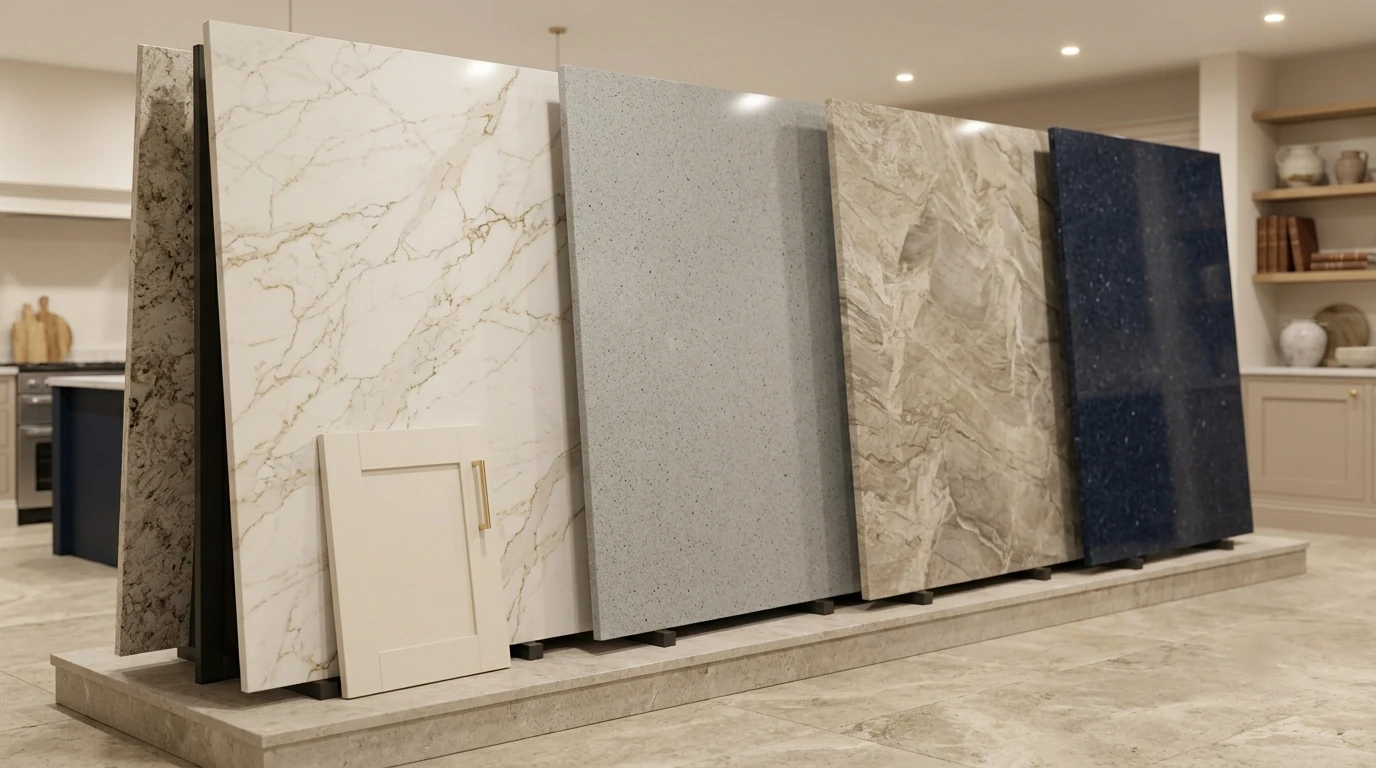
Never choose stone from a sample chip. A 4 inch sample cannot show veining scale, pattern repeat, or how a slab will look cut around your sink and cooktop. In a countertop showroom you should do four things: view the full slab standing up, check the pattern against your cabinet door in the same light, ask where the seams will fall, and confirm whether you are approving the specific slab or the material generally.
Countertops are the one material where the gap between the sample and the installed result is largest. Cabinets are consistent from door to door. Stone is not. Every slab is different, and natural stone slabs from the same quarry block can vary substantially.
Why the sample chip fails
A 4 inch by 4 inch sample tells you the color family. It does not tell you:
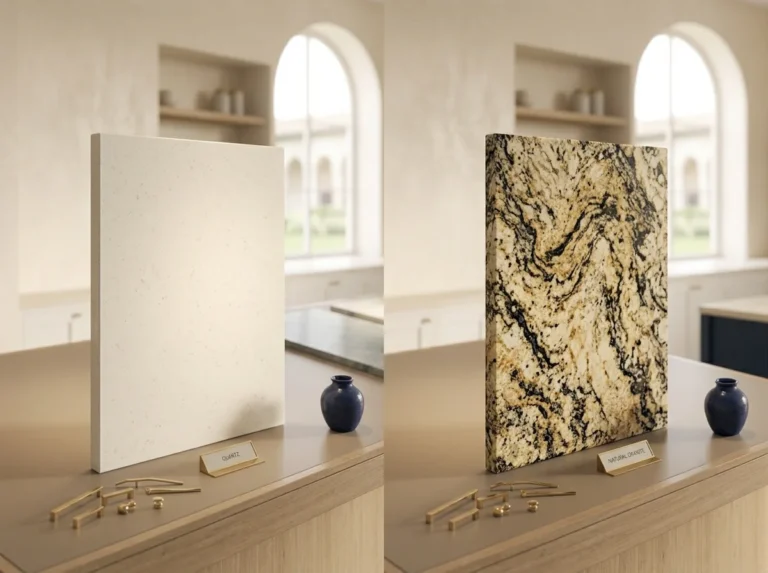
- Veining scale. A vein that reads as a delicate thread on a chip can be a four inch band across your island.
- Pattern repeat. Engineered quartz has a repeat interval. On a long run you will see it.
- Movement direction. Whether the pattern runs with or across your counter changes the whole look.
- Background consistency. Natural stone shifts in tone across a slab.
This is the mistake that generates the most regret and the least recourse, because once a slab is cut, it is cut.
The four checks to run in the showroom
1. View the slab standing, in full
Slabs are stored upright. Ask to see the whole thing with light on it. Step back ten feet, then look from three feet. Counters are seen from both distances and the pattern reads differently at each.
2. Bring your cabinet door and check them together
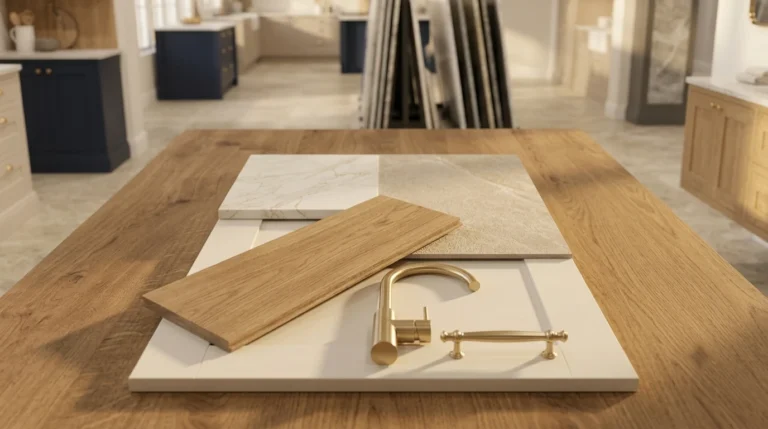
This is the single most useful thing you can carry into a countertop showroom. Undertones decide whether a combination works. A warm white cabinet against a cool grey-veined quartz fights, even though both are technically neutral.
Ask to see the pairing under different light temperatures. We keep lit displays for exactly this.
3. Ask where the seams will fall
Slabs come in finite sizes, typically around 120 by 55 inches for quartz and variable for natural stone. If your run exceeds that, you get a seam. Ask:
- Where will it be placed?
- Will the pattern be matched across it?
- Is it in a visually quiet spot, or across the middle of the island?
A well-placed seam disappears. A badly placed one is the first thing you see for the next fifteen years.
4. Confirm what you are approving
This is the question people forget. Are you approving this slab, tagged and held for you, or approving the material, with whatever slab arrives at fabrication?
For quartz, material-level approval is usually fine because engineered products are consistent within a batch. For granite, quartzite, and marble, insist on slab-level approval and tagging. Get it in writing.
What to ask about each material
| Material | Ask about | Watch for |
|---|---|---|
| Quartz | Pattern repeat, batch consistency, warranty terms | Repeat visible on long runs; heat sensitivity near cooktops |
| Granite | Sealing schedule, slab tagging, absorption | Variation across the slab; some require annual sealing |
| Quartzite | Whether it is true quartzite or a soft substitute | Mislabeling is common; true quartzite is harder than granite |
| Marble | Etching behavior, honed vs polished | Etches from lemon, wine, vinegar; a working perimeter is risky |
| Dekton and porcelain | Edge treatment, chipping at fabrication | Thin material, edges need specific detailing |
On quartzite in particular: some material sold as quartzite is dolomitic marble, which behaves nothing like quartzite in a kitchen. Ask for the scratch and acid test result, or ask the fabricator directly. Our marble vs quartzite guide covers how to tell them apart.
Remnants: the underused option
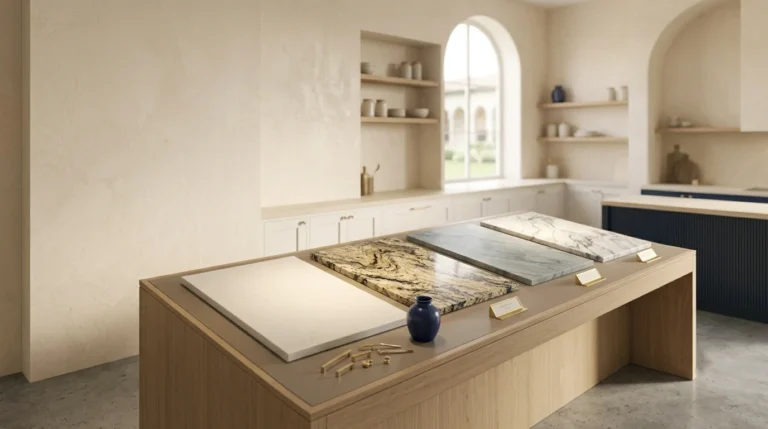
For a small vanity, a bar top, or a laundry counter, ask about remnants. These are the usable leftovers from larger jobs, priced substantially below a full slab. You are limited to what exists rather than what you would choose, but for a powder room vanity that constraint costs little and saves real money.
What to bring with you
- A cabinet door or finish sample in your actual selection
- Your flooring sample, since three surfaces have to agree, not two
- Rough dimensions of the counter runs, so seam locations can be discussed
- Photos of the room in daylight
- Your backsplash idea, or the willingness to choose it after the stone
Choose stone before backsplash, not the other way around. Stone is the constrained material with fewer options; tile has thousands. Let the harder decision lead.
Frequently asked questions
Can I pick countertops from a sample?
You can narrow options from a sample, but you should not make the final selection from one. A 4 inch sample cannot show veining scale, pattern repeat, or tonal shifts across a full slab. For granite, quartzite, and marble, view and tag the specific slab before fabrication.
What should I ask when choosing a countertop slab?
Ask where seams will fall and whether the pattern is matched across them, whether you are approving this specific slab or the material generally, what the sealing requirements are, and how the edge profile will be detailed. Bring your cabinet door to check undertones together.
Do I need to see the actual slab or just the material?
For engineered quartz, material-level selection is usually acceptable because batches are consistent. For granite, quartzite, and marble, you should view and tag the specific slab, since natural stone varies significantly even within the same quarry block.
What is a countertop remnant and is it worth using?
A remnant is usable leftover stone from a larger fabrication job, sold below full-slab pricing. Remnants work well for vanities, bar tops, and small counters where the limited selection is not a constraint. They are not practical for full kitchen runs.
—
Come see full slabs, not chips. Our Derwood showroom displays countertop lines at scale. Call (301) 939-0009 or book a visit.
See the slabs in person at our showroom
Book a free showroom visit and compare your options in person under real lighting.
Book Showroom Visit →