Cabinet Showroom vs Big Box Store: Which Should You Actually Use?
A cabinet showroom wins on construction quality, finish accuracy, and order accountability. A big box store wins on price and speed for simple jobs. Here is the honest split.
Use a cabinet showroom when the kitchen is a full renovation, when the layout is not a simple rectangle, or when you want plywood construction and finish accuracy you can verify by hand. Use a big box store when the job is a straightforward replacement in a standard layout, the budget is tight, and stock sizes fit without modification. The real difference is not quality alone, it is who owns the problem when something is wrong.
We are a showroom, so read this with that in mind. We have also lost sales to big box stores where the customer made the right call, and we will say where those cases are.
The structural differences
| Factor | Cabinet showroom | Big box store |
|---|---|---|
| Box construction | Plywood standard on most lines | Particleboard common at entry price |
| Available sizes | Semi-custom, 3 inch increments, modifications possible | Stock sizes, limited modification |
| Finish options | Broad, including custom color matching | Limited palette per line |
| Door styles | Dozens per line | A handful |
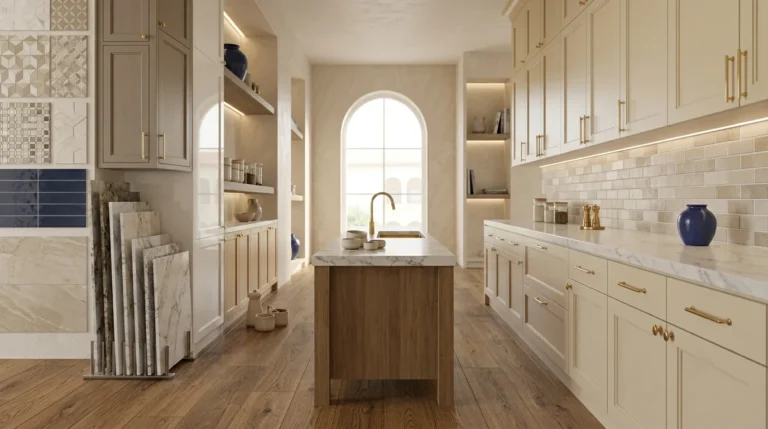
| Seeing the actual product | Full display kitchens, open the drawers | Door samples, partial displays |
| Design support | Specialist who does this daily | Varies widely by store and staffing |
| Lead time | 4 to 10 weeks semi-custom, some quick-ship | Often faster on stock |
| Price | Higher per linear foot | Lower entry point |
| Order errors | Showroom resolves with the manufacturer | You often manage it yourself |
When the big box store is the right answer
Genuinely, these cases exist:
- A rental property or a flip where the goal is clean and functional, not durable for fifteen years.
- A simple galley or L-shaped kitchen where stock sizes fit wall to wall without fillers or modifications.
- A tight budget where the alternative is not remodeling at all. A functioning particleboard kitchen beats a broken one.
- You are the contractor. If you can measure, order, verify, and install yourself, you are absorbing the coordination that a showroom otherwise provides.
If you are in one of those cases, take the savings. We would rather tell you that than sell you a kitchen you did not need.
When the showroom pays for itself
The layout is not a clean rectangle
Angled walls, out-of-plumb corners, a peninsula, a bumped-out window, or ceilings that vary by an inch across the run. Stock cabinets in 3 inch increments handle this with filler strips, which look like filler strips. Semi-custom handles it with modified boxes.
Montgomery County housing stock produces this constantly. Homes from the 1940s through 1960s in Bethesda, Silver Spring, and Kensington are rarely square.
You care about what you touch
Drawer glide weight, hinge quality, and door alignment are felt every day and are almost impossible to evaluate from a door sample stapled to a display board. In a showroom you open a full drawer bank loaded to weight. That is a different piece of information.
The finish has to be right
Cabinet finishes shift under different light temperatures. A white that reads warm under 3000K showroom light reads grey under 4000K LED. We keep lit displays specifically so you can check this, because a finish decision made under the wrong light is discovered after installation, when it is unfixable.
Something will go wrong
On a full kitchen, something arrives damaged, mismeasured, or backordered. The question is who chases it. A showroom has an account manager at the manufacturer and places orders weekly. That relationship is most of what you are paying for, and you only notice it when you need it.
What the price difference actually buys
A semi-custom kitchen from a showroom typically runs 30 to 60 percent more per linear foot than an entry stock line. That gap covers, roughly in order of value:
- Plywood boxes instead of particleboard. Particleboard fails at the sink base first, when it gets wet. This is the single most common cabinet failure we see.
- Full-extension soft-close hardware as standard rather than an upgrade.
- Modifications so boxes fit your walls instead of fillers hiding the gap.
- Finish range and consistency, including matched accessories and panels.
- Order management by someone whose job is that order.
For a comparison of the specific lines we carry and how they differ, see our cabinet brand comparison guide or browse kitchen cabinets in Maryland.
The question that settles it
Who fixes it when the order is wrong?
If your answer is “me, and I am fine with that,” a big box store is a reasonable choice and you should take the savings. If your answer is “I want someone whose name is on this to handle it,” that is what a showroom sells, and the premium is priced against that.
At H&C, that goes one step further, because our sister company H&C Construction installs. When a cabinet arrives damaged, the same organization that ordered it reschedules the crew. Split responsibility between a retailer and an unrelated installer is where kitchens lose weeks.
Frequently asked questions
Are cabinet showroom prices higher than big box stores?
Yes, typically 30 to 60 percent more per linear foot. The difference covers plywood construction rather than particleboard, full-extension soft-close hardware as standard, size modifications, a wider finish range, and order management with the manufacturer.
Is it worth buying kitchen cabinets from a showroom?
It is worth it when the kitchen is a full renovation, when walls are not square, when finish accuracy matters, or when you want someone accountable for order problems. It is not worth it for rentals, flips, or simple layouts where stock sizes fit without modification.
What is the difference between stock and semi-custom cabinets?
Stock cabinets come in fixed sizes, usually 3 inch increments, with limited finishes and no modification. Semi-custom cabinets offer size modifications, a wider range of door styles and finishes, and typically plywood construction. Semi-custom lead times run 4 to 10 weeks versus faster availability on stock.
How can I tell if kitchen cabinets are good quality?
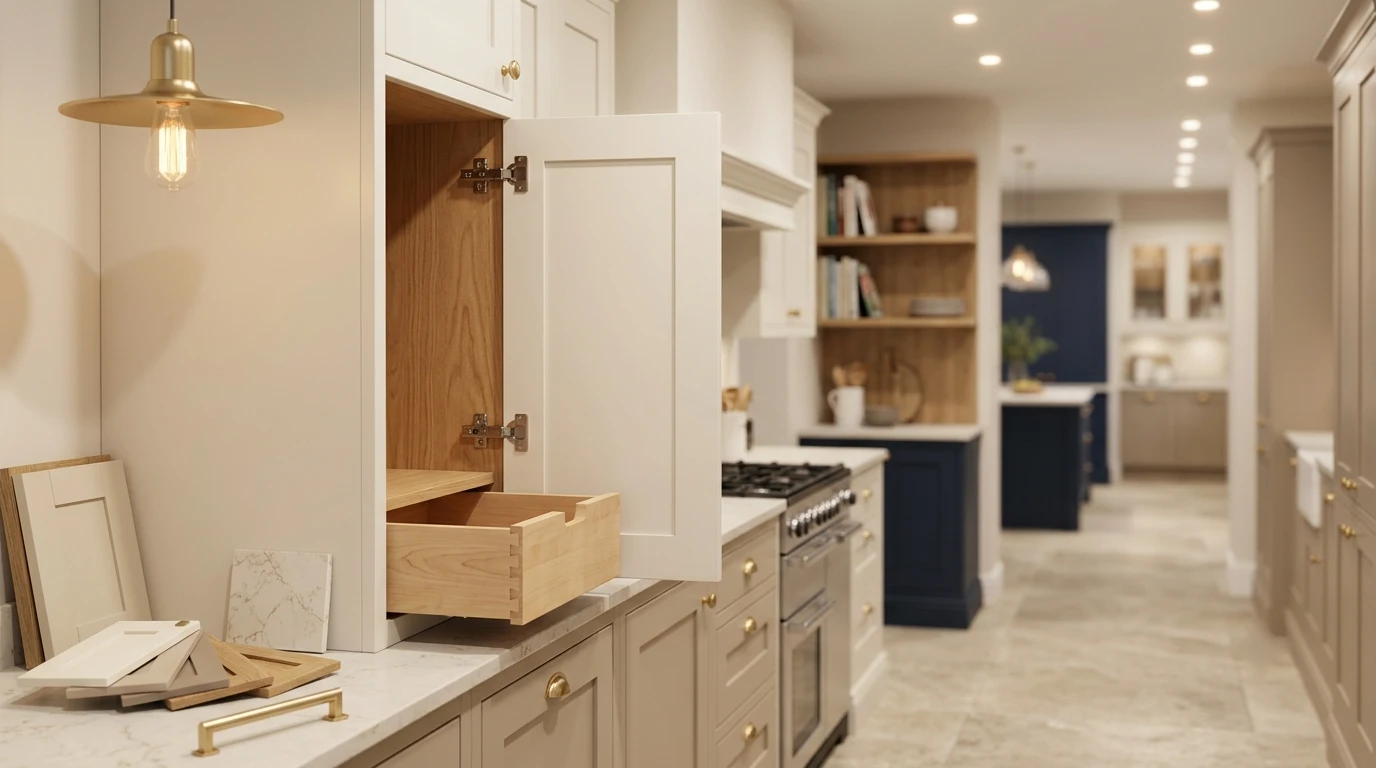
Check the box material, plywood over particleboard, especially at the sink base. Open a loaded drawer and feel the glide. Check that doors align and hinges are adjustable. Look at how drawer boxes are joined, with dovetail construction indicating higher quality than stapled butt joints.
—
Compare them side by side. Our Derwood showroom has full display kitchens from multiple lines. Call (301) 939-0009 or book a visit.
See the slabs in person at our showroom
Book a free showroom visit and compare your options in person under real lighting.
Book Showroom Visit →